Before becoming one of the most collected sneakers in the world, the Nike SB Dunk was simply a solution found by skaters within the Nike basketball archives.
The original silhouette was actually created for the hardwood in 1985. Nearly twenty years later, Nike Skateboarding officially transformed it into a shoe designed for skating, starting a history made of skate shops, artists, musicians, independent brands, and collaborations that would deeply change sneaker culture.
Today, talking about Nike SB Dunk means talking about skateboarding, design, and collecting all at once. Some colorways have become nearly unattainable grails, others were cancelled before release, and others still have told stories of music, cinema, art, or local culture through a single sneaker.
1985: before the Nike SB, there was the Nike Dunk
The story begins in 1985, when Nike developed the Dunk as part of the College Colors program.
The sneaker was created as a basketball shoe and used colors linked to American universities, as part of a campaign that would become famous for the message “Be True to Your School”.
The design drew elements from various Nike silhouettes of the era and built a relatively simple shoe: leather upper, sturdy construction, and a flat sole.
It was precisely some of these characteristics, created for basketball, that would later catch the attention of skaters.
In the nineties, Dunks could be found at relatively low prices in outlets and stores. For those who skated, they offered an interesting combination of grip, support, and durability, despite not having been specifically designed for skateboarding.
The relationship between the Dunk and skating therefore began before the existence of Nike SB.
2002: Nike SB is officially born
Nike had already tried to enter the skate world during the nineties, but those initial projects had failed to fully win over a culture that was highly suspicious of big sports brands.
In 2002, the approach changed.
With Sandy Bodecker as the central figure of the project, Nike SB sought to understand skate shops, riders, spots, and the community before imposing a product from above.
The Dunk was therefore modified to become more suitable for skateboarding without losing its original shape.
Increased padding was added to the tongue and collar, constructions were designed to withstand skating, and Zoom Air cushioning was included in the insole.
Most importantly, however, Nike gave riders the chance to tell their own stories through the shoe.
The first riders involved were Richard Mulder, Danny Supa, Reese Forbes, and Gino Iannucci.
Each one was given the chance to customize the Dunk Low Pro SB through colors and materials linked to their own personal history.
This was the so-called Colors By Series.
The Mulder model calls back to Los Angeles and the first Nikes the rider ever owned. The Supa utilizes colors tied to the sports culture of New York. Reese Forbes worked with tones inspired by American work boots, while Gino Iannucci chose a darker, more minimal combination.
These sneakers immediately defined one of the most important rules of the Nike SB Dunk: the silhouette remains recognizable, but the story changes completely based on the person interpreting it.
The history of the Dunk SB is often divided through the so-called Box Eras, named for the color and design of the boxes used by Nike Skateboarding in different periods.
The official Nike SB archive now distinguishes these phases:
- Orange Box: March 2002 – December 2002;
- Silver Box: January 2003 – September 2004;
- Pink Box: September 2004 – December 2005;
- Black Box: February 2006 – September 2007;
- Gold Box: October 2007 – March 2009;
- Blue Box: April 2009 – June 2012;
- Taped Box: July 2012 – November 2013;
- Teal Box: December 2013 – December 2019;
- Striped Box: January 2020 – March 2023;
- Sail Box: from March 2023.
This classification isn't just useful for collectors to identify the period of a sneaker. It also allows one to observe how the role of the Dunk has changed over time.
Between 2003 and 2004, Nike SB began to move rapidly away from the idea of a simple technical sneaker.
The Dunk became a platform capable of using references from music, cinema, food, art, cities, and pop culture.
One of the sneakers that best represents this freedom is the Nike SB Dunk Low Heineken from 2003.
Green, white, red, and the embroidered star immediately recalled the famous Dutch brewery, even without being an official collaboration. The legal controversy and subsequent withdrawal transformed the sneaker into one of the first great examples of how a story external to the product can become an integral part of its myth.
This was a period in which Nike SB experimented rapidly and built the language that would make subsequent Dunks much more than just colorways.
Between 2004 and 2005, the Dunk SB reached one of the most important moments of its first phase.
In 2005, the collaboration with Diamond Supply Co. arrived, giving life to the sneaker known to everyone as the Tiffany Dunk.
Diamond Blue, black crocodile-effect leather, and a silver Swoosh transformed the Dunk into an object that could be desired even by those with no connection to skateboarding.

During the same period, Jeff Staple's Pigeon Dunk helped make the phenomenon of queues, limited drops, and the competition to purchase certain sneakers visible on a much larger scale.
The Dunk SB was gradually moving out of skate shops alone to become one of the symbols of 2000s sneaker culture.
A fundamental part of Nike SB's growth came through independent skate shops.
From the beginning, Nike chose selective distribution and worked with shops capable of truly representing their respective communities.
Over time, these shops also became creative partners.
Supreme, Concepts, and many other entities used the Dunk to tell the stories of cities, subcultures, and local identities.
It is a different model compared to the standard collaboration between two large multinationals: often, the value of the sneaker stems precisely from the ability to transform a very specific and local reference into something globally understandable.
The Nike SB Dunk Low Freddy Krueger from 2007 represents one of the most extreme cases.
The sneaker drew directly from the famous character from A Nightmare on Elm Street through green and red stripes, a metallic Swoosh, and details inspired by his horror imagery.
However, the project ran into conflict with the rights associated with the character, and the normal distribution was blocked.
A few examples survived and began to circulate among collectors, transforming what was supposed to be a standard Nike SB release into one of the most famous grails in the history of the silhouette.

Its importance shows a particular characteristic of Nike SB culture: even a sneaker that doesn't normally reach the market can become fundamental to the model's history.
In 2007, one of the most radical interpretations of the Dunk also arrived.
The Nike SB What The Dunk used elements from dozens of previous Nike SB releases and combined them on two intentionally different shoes.
Pigeon, Supreme, Cali, Jedi, and numerous other references were reassembled in a kind of three-dimensional collage of the SB archive.
It is an important project because, in order to work, it already required the existence of a shared culture.
The public had to know the previous releases to understand the references. In just five years, Nike SB had already accumulated enough history to start referencing itself.
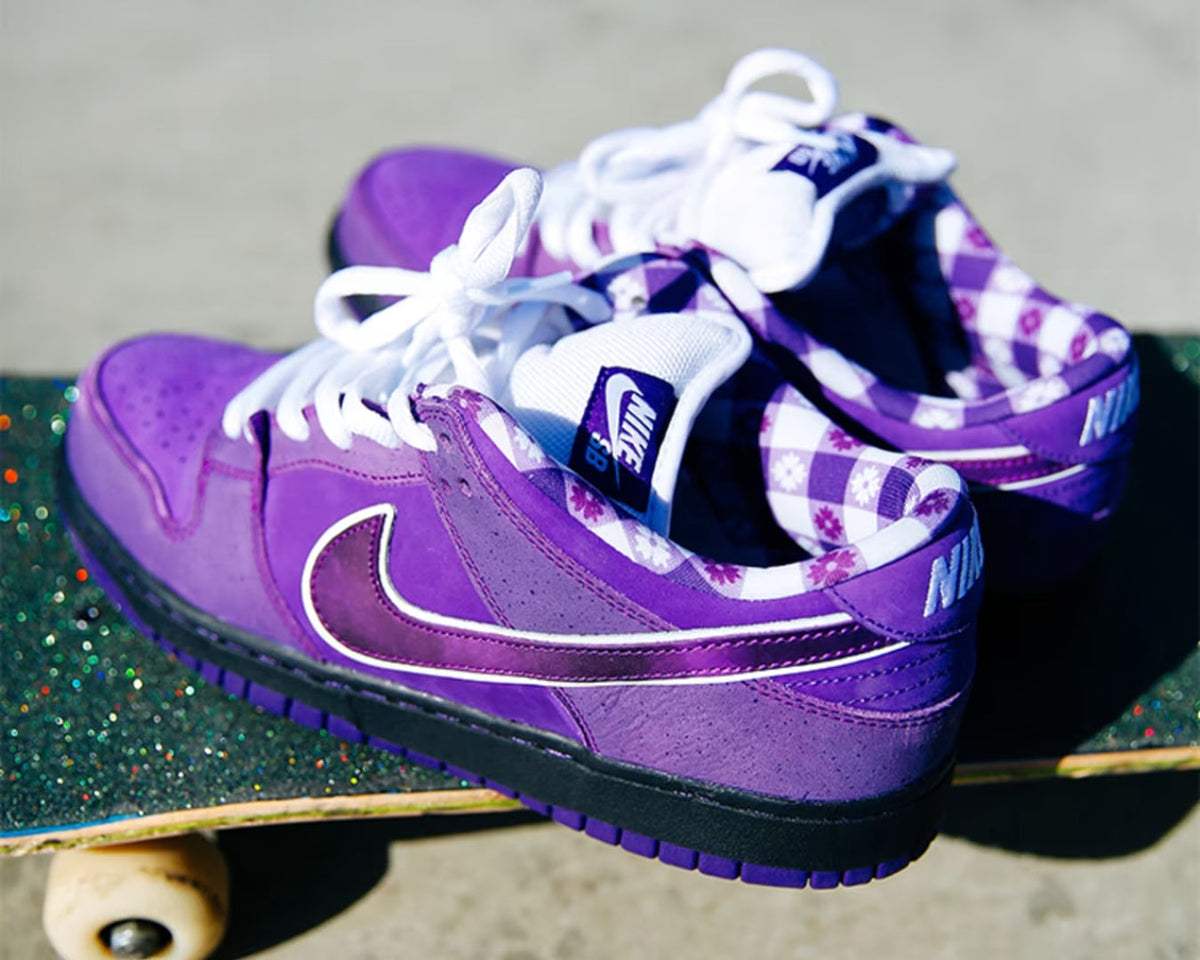
In 2008, Concepts brought one of the most characteristic symbols of New England to the Dunk: the lobster.
The first Red Lobster introduced suede with irregular shading, lining inspired by seafood restaurants, and, above all, the rubber band on the toe box that recalled the bands applied to lobster claws.
That project would become a true saga through Blue, Yellow, Purple, Green, Orange, and White Lobsters.

The history of the Nike SB Dunk Lobster perfectly represents one of the strengths of the Dunk: taking something deeply local and transforming it into a language recognizable all over the world.
During the 2010s, the level of hype around the Dunk changed.
Other silhouettes gained centrality in the sneaker market, and the SB Dunk went through a phase that was less dominant than the first half of the 2000s.
This does not mean, however, that Nike SB stopped producing important collaborations.
The relationship with skate shops, artists, and brands continued, while numerous older releases began to become increasingly collectible precisely because they belong to a period now perceived as historic.
The Teal Box Era, from 2013 to 2019, also paved the way for the grand return of the silhouette at the end of the decade.
Between 2019 and 2020, the Dunk suddenly returned to the center of sneaker culture.
Demand increased, old collaborations were rediscovered, and Nike SB presented a sequence of releases capable of simultaneously interesting skaters, collectors, and the mainstream public.
In 2020, projects like Travis Scott, Ben & Jerry's, and the Nike SB Dunk Low Grateful Dead arrived.
The latter transformed the band's famous Marching Bears into three Orange, Yellow, and Green sneakers through shaggy materials, serrated Swooshes, and a hidden pocket in the tongue.

The Dunk thus returned to being one of the most desired products on the sneaker market, but with one difference compared to 2005: social networks, resale platforms, and global releases amplified the hype at a completely different speed.
Modern Nike SB history also continues through cancelled projects.
In 2020, the Nike SB Dunk Low 7-Eleven emerged, characterized by the colors and branding of the famous convenience store chain.
The sneaker was produced, but the normal release was cancelled. The precise reason for the stoppage was not publicly disclosed.
However, some physical examples continued to circulate, transforming the 7-Eleven into another demonstration of the peculiar relationship between Nike SB and the concept of the grail.
The return of the Dunk did not end in 2020.
During the Striped Box Era, Nike SB consolidated the silhouette once again through collaborations, reinterpretations of the archive, and new projects.
Since March 2023, the official Nike SB archive has instead identified the contemporary phase as the Sail Box Era.
The interesting thing is that, after more than twenty years of Nike SB, the Dunk continues to function with the same narrative structure as its origins: a relatively simple silhouette that completely changes identity based on who interprets it.
In 2024, Futura 2000 returned to collaborate with Nike SB through a Dunk Low built around his own abstract language.
The Nike SB Dunk Low Futura 2024 uses canvas, colored overlays, and a translucent sole that reveals the artist's signature.

Alongside the retail version, there also exists the very rare Friends & Family Sunblush, demonstrating how the relationship between art, public release, and collecting remains central even in the contemporary phase of the Dunk.
The Nike SB Dunk Low Nardwuar from 2025 represents a different kind of storytelling.
The tartan derives from the Canadian journalist's famous tam o' shanter. The pom-pom becomes an accessory attachable to the laces, and the phrase “Doot doola doot doo” is incorporated into the shoe.
You don't need to know a historical colorway or a Nike reference to understand the project: practically every element directly tells the story of the person to whom the sneaker is dedicated.
It is a demonstration of how the Nike SB format developed in 2002 is still usable more than twenty years later.
There is no single formula.
Some sneakers become rare because they were produced in very limited quantities. Others because they were intended exclusively for Friends & Family. Some are cancelled, and others simply gain cultural value over time.
Availability, however, is not enough.
The most important Nike SBs almost always have an easily recognizable story. Heineken recounts a legal controversy. Tiffany represents Diamond Supply Co. and a fundamental moment in SB culture. Freddy Krueger is inseparable from its cancellation. Lobster tells the story of Concepts and Boston. Grateful Dead links skate and music.
It is this combination of design, context, and scarcity that transforms certain releases into true sneaker grails.
No.
The Nike Dunk was originally created as a basketball silhouette and exists today primarily as a lifestyle sneaker.
The Nike SB Dunk derives from the same base, but is modified for skateboarding through padding, construction, cushioning, and other details that can change according to different generations.
The distribution and culture around the two lines are also historically different.
The lifestyle Dunk is normally distributed through traditional Nike channels, whereas Nike SB has built a special relationship with selected skate shops from the very beginning.
It is precisely this network of shops, riders, and collaborators that has contributed to creating the cultural identity of the SB.
Why the Nike SB Dunk became much more than a skate shoe
The Nike SB Dunk didn't invent the sneaker collaboration, and it wasn't the only important shoe in the history of skateboarding.
However, it offered something particularly effective: a silhouette simple enough to tell practically any story.
Over the years, it has become beer, lobster, horror characters, artists, bands, skate shops, cities, and even a collage of its own previous releases.
The shape remains instantly recognizable, while materials, colors, and small details can completely change the sneaker's meaning.
It is this balance between continuity and creative freedom that has allowed the Dunk SB to span more than twenty years without depending on any single era of hype.
From the Orange Box to the Sail Box: an ongoing story
In 2002, Nike SB had to convince a skeptical skate culture that a big sports brand could truly understand its language and community.
More than twenty years later, the Dunk SB possesses one of the most recognizable archives in the entire sneaker market.
Orange Box, Silver, Pink, Black, Gold, Blue, Taped, Teal, Striped, and Sail do not just represent different boxes. They tell of moments when the Dunk changed its audience, relevance, and relationship with the culture surrounding it.
The sneakers that built this path are very different from each other, but they share the same idea born in the early Nike SB years: letting riders, artists, shops, and creatives transform a Nike silhouette into their own story.
And it is precisely for this reason that the story of the Nike SB Dunk cannot be considered finished: every new collaboration still has the possibility of adding another chapter to an archive that officially began in 2002.