Some sneakers become legendary thanks to an official collaboration. The Nike SB Dunk Low Heineken became famous for practically the opposite reason.
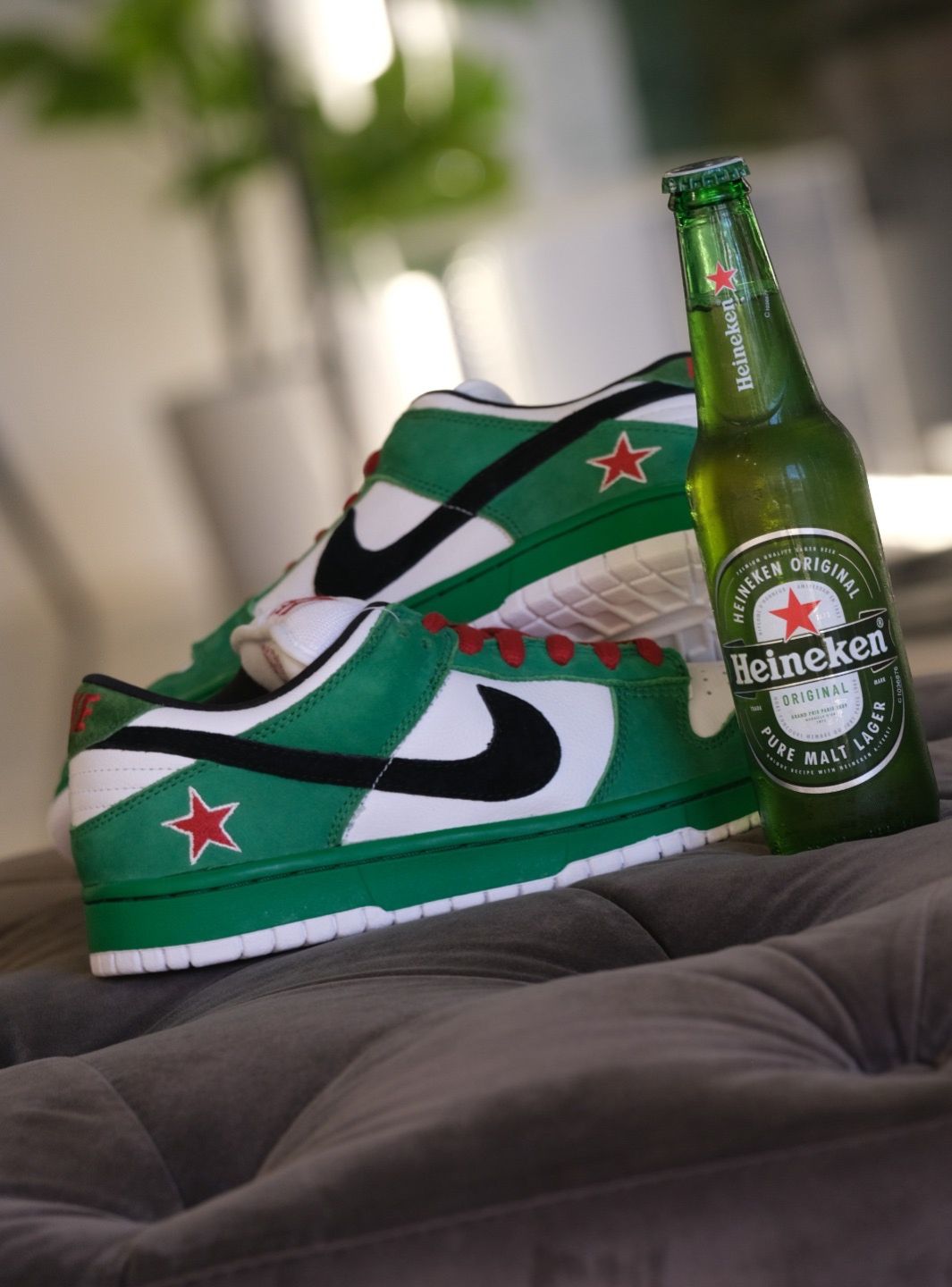
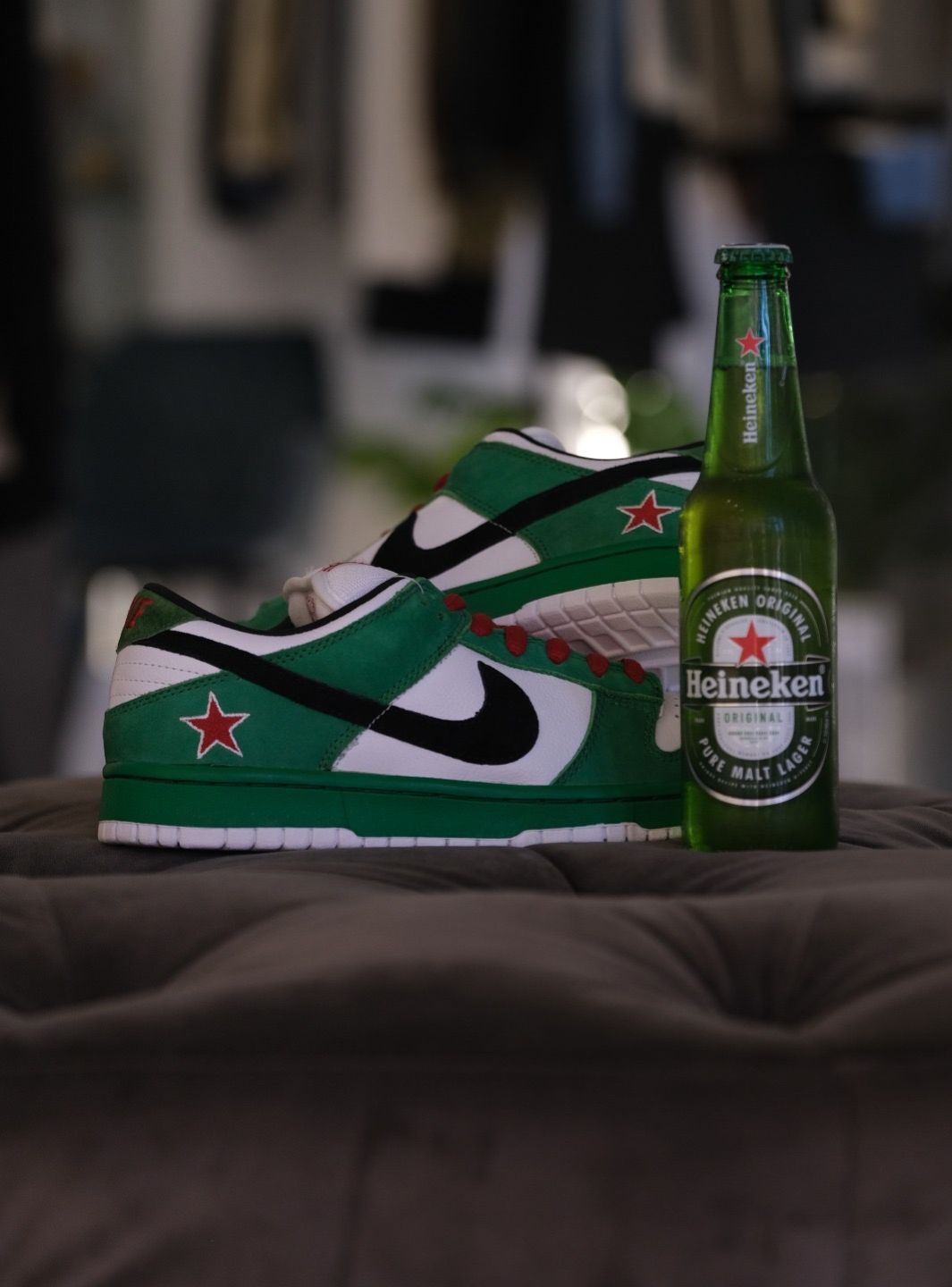
Released in 2003, during the early years of the Nike Skateboarding division, it uses a combination of green, white, black, and red so close to the visual identity of the famous Dutch beer that it immediately earned the nickname “Heineken.”
The problem is that it was not an official collaboration. The resemblance led to a legal dispute and the withdrawal of the sneaker, helping to turn an already unique Nike SB Dunk into one of the most recognizable models of the Silver Box era.
2003: Nike SB was still at the beginning of its history
To understand why the Heineken became so important, we need to go back to the early 2000s.
Nike SB was officially launched in 2002 and was still building its credibility within a skate culture that initially looked at Nike with a certain amount of distrust.
The Dunk was adapted for skateboarding through increased padding, more durable construction, and dedicated cushioning, but it was primarily the way Nike SB used colors, themes, and limited distribution that quickly made it different from the original basketball Dunk.
The releases of the early 2000s began to draw inspiration from music, art, places, products, and very different cultural references.
The Heineken represents one of the most extreme examples of that creative freedom.
The design of the Nike SB Dunk Low Heineken
You only need to look at the sneaker to understand why it received that nickname.
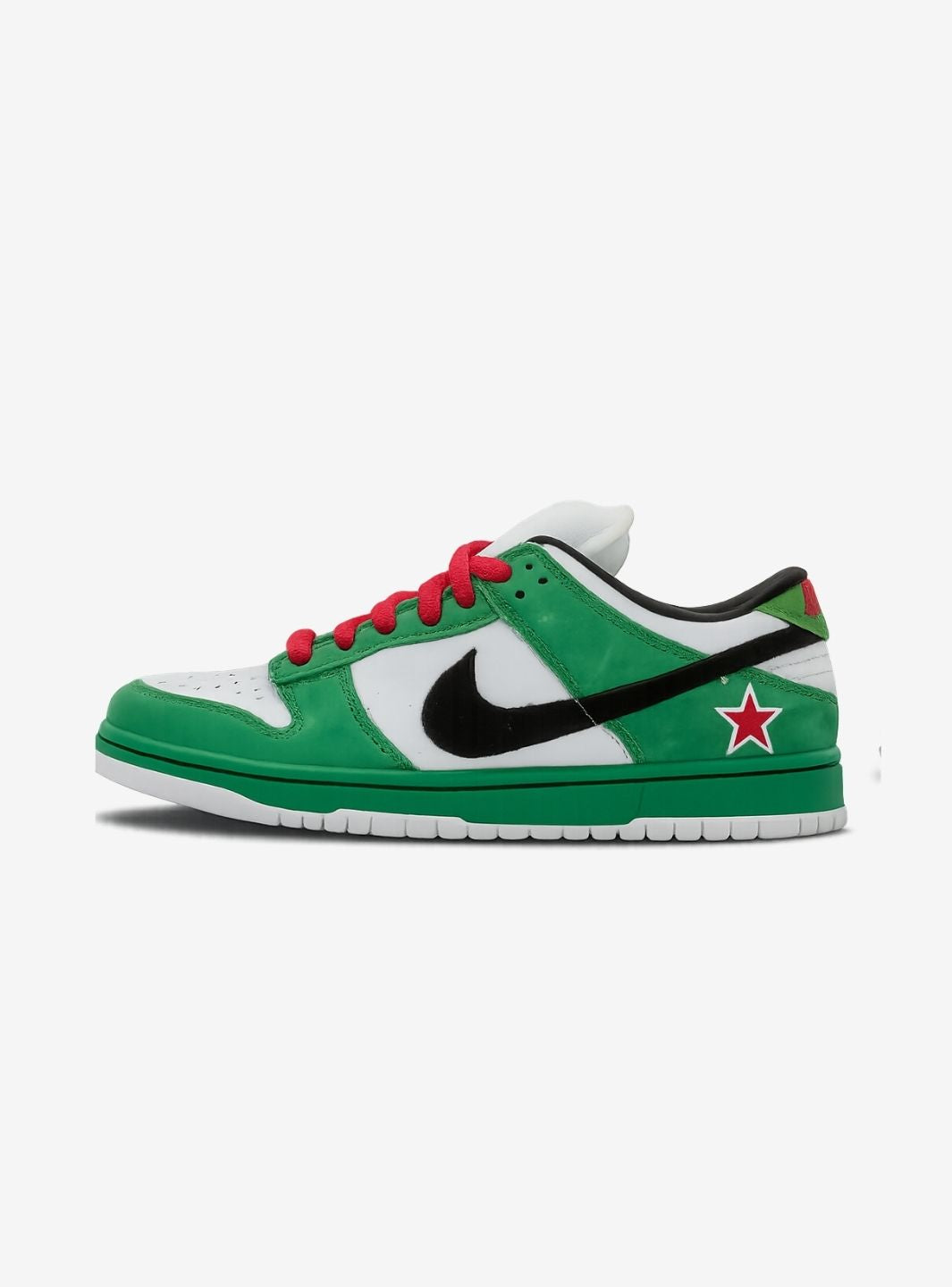
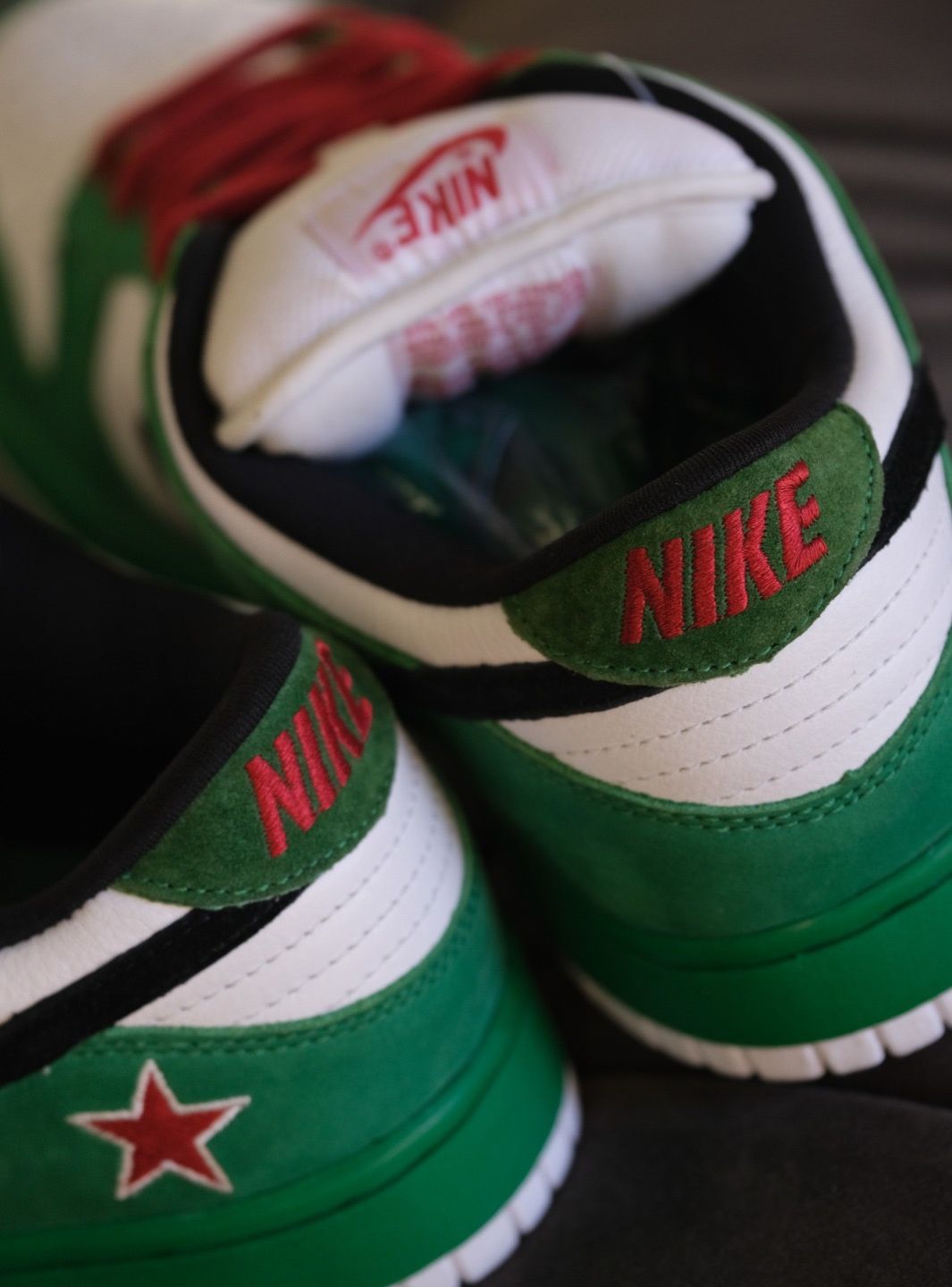
The overlays use a deep green, while the white leather base creates the main contrast. The black Swoosh crosses the side of the shoe, and the red laces introduce the color that completes the palette.
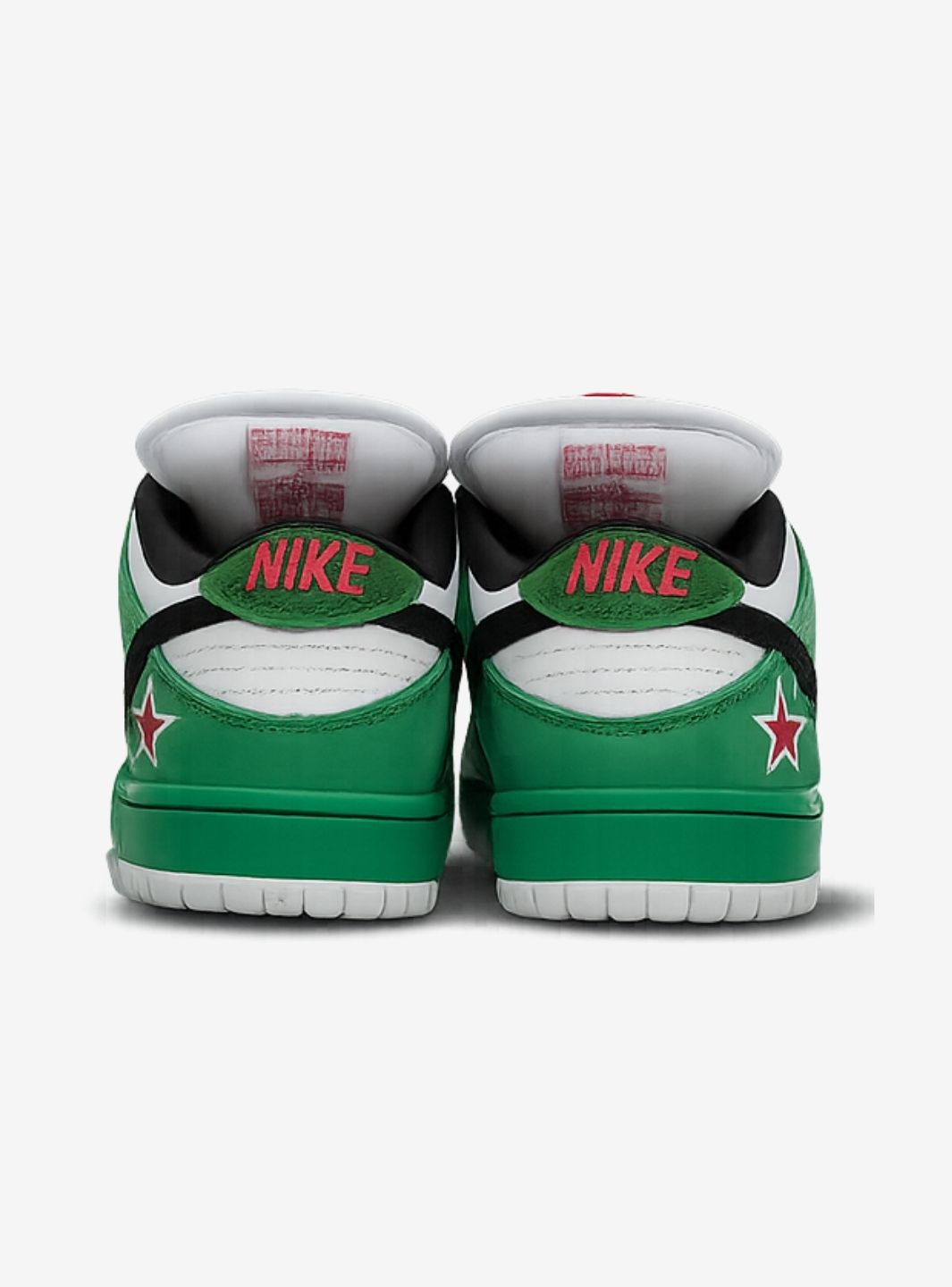
However, the most important detail is found on the back: a red star embroidered on the green panel.
It is precisely the combination of green, white, black, red, and that star that makes the reference to the Heineken visual identity particularly evident, even though the brewery's name does not appear on the sneaker.
The result is a simple but immediately recognizable colorway, so much so that it is still difficult to confuse it with any other SB Dunk from the same era.

The Nike SB Heineken was not an official collaboration
This is one of the most important aspects to clarify.
The sneaker is commonly called the “Heineken,” but Nike and the Dutch brewery had not developed the project together.
The name by which it is known originated from the community and the immediate connection between its palette and the beer brand's identity.
This clearly distinguishes the model from modern collaborations, where branding, licensing, communication, and distribution are agreed upon directly between the companies involved.
In the case of the 2003 Dunk, the reference was instead clear enough to create a problem precisely because it had not been authorized.
The Heineken cease-and-desist and the withdrawal of the sneaker
The legal affair has become an integral part of the shoe’s legend.
After the Dunk hit the market, lawyers associated with Heineken intervened, challenging the reference to the brand's identity.
The sneaker was therefore pulled from shelves and distribution was halted.
The case did not remain limited only to Nike. In the following years, even publications that continued to use the “Heineken” nickname received requests from Dutch law firms to stop calling the sneaker by that name.
However, the attempt to separate the model from the name of the brewery had practically the opposite effect in sneaker culture: the nickname had by then become inseparable from the Dunk.
Was it really a “cancelled” sneaker?
Here it is important to distinguish the Heineken from other famous Nike SB projects that were blocked before ever actually reaching the public.
The Heineken was actually distributed in 2003. Some pairs reached stores and were sold before the controversy led to the withdrawal.
It is therefore incorrect to describe it as a sneaker that was never released.
It is more accurate to speak of an interrupted release: the model managed to reach the market, but its normal commercial life was brought to a premature end.
This is also what differentiates it from cases like prototypes, samples, or Friends & Family pairs that never had a retail release.
Why the controversy made the Heineken even more famous
In sneaker collecting, an exceptional story can be almost as important as the design.
The Heineken already possessed an extremely recognizable palette and belonged to the early years of Nike SB. However, the withdrawal added an element impossible to engineer: a genuine controversy surrounding the very existence of the sneaker.
The model thus began to represent a period in which Nike SB appeared more experimental, unpredictable, and tied to underground culture.
In the following years, the story was passed down through forums, sneaker magazines, and communities long before the current ecosystem of social media, leaks, and global release calendars.
The increasing rarity of the original pairs completed the transformation of the Heineken from a simple colorway to a true collector's item.

The Heineken in the Nike SB Silver Box era
The sneaker belongs to the so-called Silver Box era, one of the first chapters in Nike SB history.
Today that phase is remembered above all for the experimental approach with which Nike began to transform the Dunk into a cultural platform as well as a skate shoe.
The Heineken became one of the most recognizable images of that era because it brings together practically all the characteristics we associate with early SB Dunks: limited distribution, unconventional storytelling, an immediately legible design, and a very close relationship with the culture of the period.
It is precisely this historical provenance that makes it interesting even for those who collect sneaker grails and not just Nike SB.
How much are Nike SB Dunk Low Heinekens worth today?
More than twenty years after the release, establishing a single value for a Heineken is practically impossible.
The price depends heavily on size, condition, completeness of the packaging, provenance, and level of wear. On a 2003 sneaker, the difference between a deadstock pair, one well-preserved, and one heavily worn can be enormous.
Over the years, the model has reached prices of several thousand euros, but listings, seller demands, and actual sales should not be confused with one another.
Therefore, there is no universal price, nor is it correct to state that every pair is automatically worth five figures.
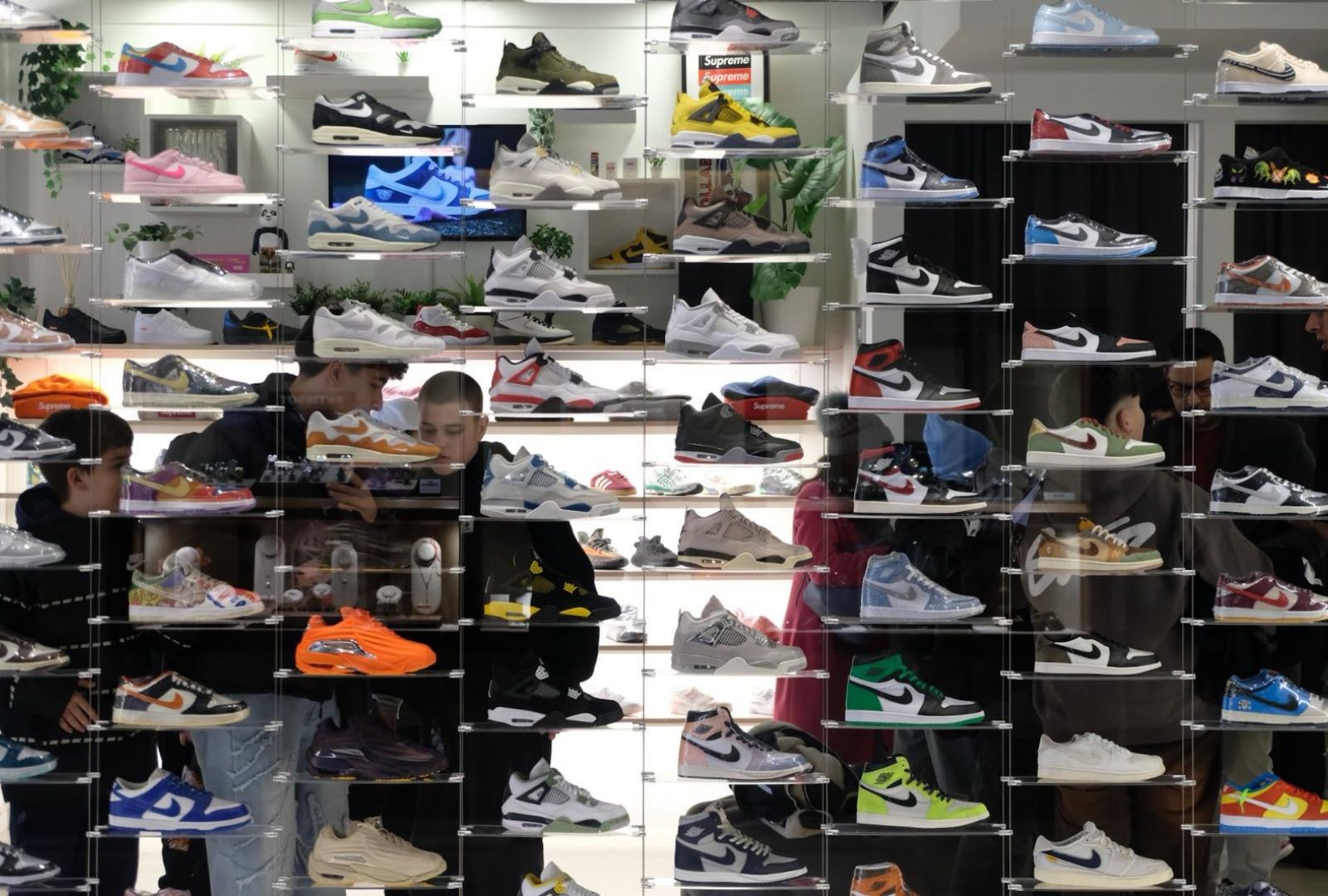
The Nike SB Dunk Low Heineken is also present in the ResellZone selection, where availability and condition of the model can be evaluated on a case-by-case basis.
Why the Heineken continues to be a Nike SB grail
Its importance does not depend solely on scarcity.
There are Nike SBs produced in smaller quantities and models with even higher economic values. The Heineken remains special because its story perfectly represents the identity of the early SB Dunks.
The design stems from an immediately recognizable cultural reference. That reference generates a real controversy. The controversy interrupts the distribution. The withdrawal increases the rarity, and over time, that same story becomes inseparable from the sneaker.
Each element therefore contributes to the next.
It is this trajectory, even more than the simple price, that has transformed the Heineken into one of the symbolic models of the first Nike SB generation.

A sneaker that tells of a different era in SB culture
Looking at a Nike SB Dunk Low Heineken today means observing something that could hardly be created in the same way in the contemporary market.
Today, a project that so clearly references another company's identity would normally be developed through agreements, licensing, and an official collaboration, or modified before hitting the market.
In 2003, that line was crossed, and the consequences unintentionally ended up building a fundamental part of the sneaker’s myth.
The Heineken remains, therefore, much more than a green and white Dunk. It is the story of a moment when Nike SB, skate culture, design, and pop culture met in a much less predictable way, leaving behind some of the most fascinating models in the entire history of the Dunk.