


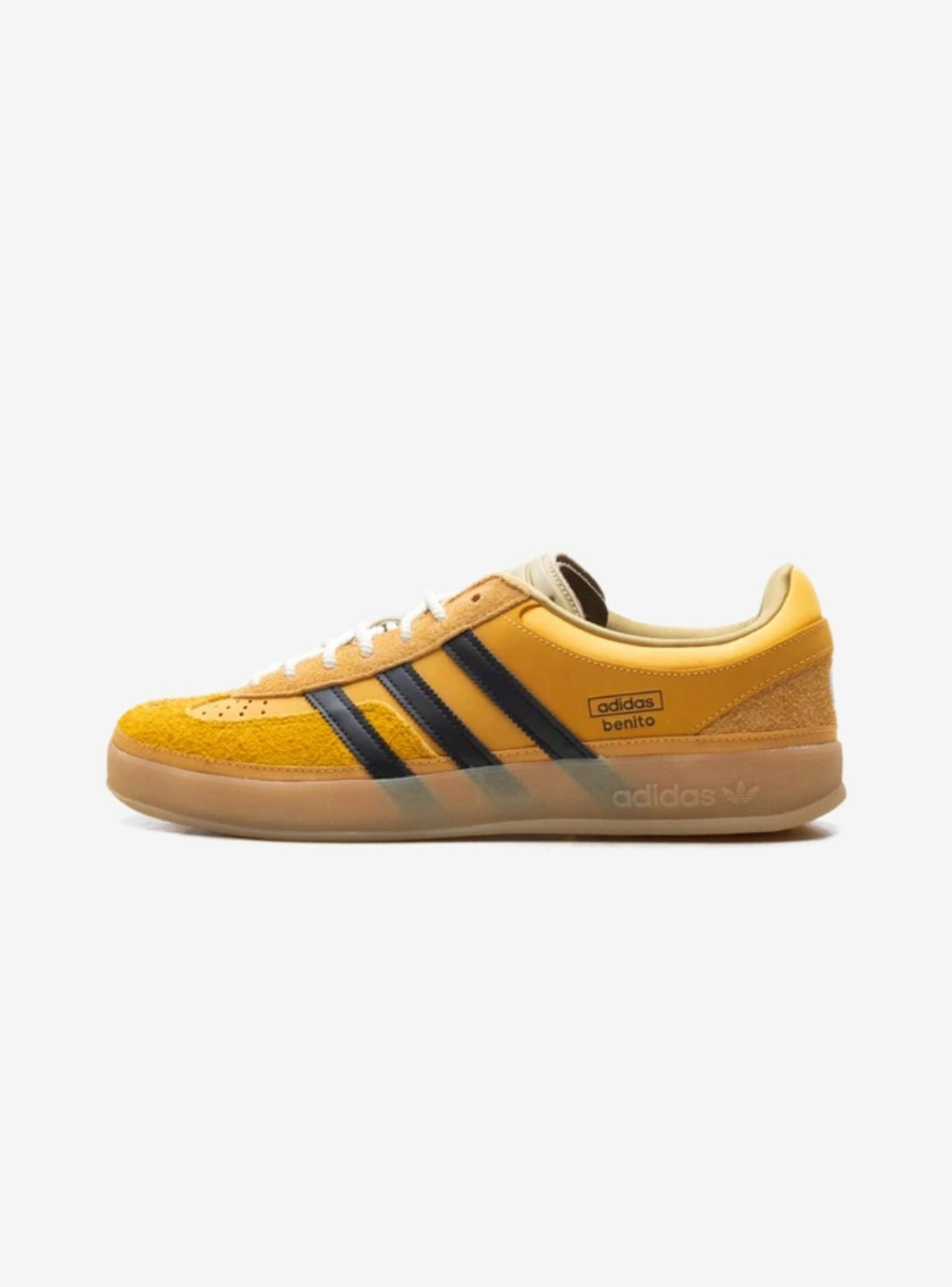


Adidas Gazelle: history, design and sneaker culture
The Adidas Gazelle debuted in 1966 as a versatile sports sneaker and over time became one of the most recognizable silhouettes in the Three Stripes archive.
The first versions were developed with different functions: a red configuration was designed for indoor sports, while the blue one was created primarily as a training shoe. Both shared a suede upper and a relatively simple design, features destined to become central to the Gazelle's identity.
From sports, the silhouette progressively entered fashion, music and European subcultures, transforming into one of the longest-running lifestyle sneakers in the Adidas catalog.
The design of the Adidas Gazelle
The Gazelle uses an essential construction, characterized by a low profile, lateral Three Stripes and “Gazelle” branding positioned on the side of the sneaker.
Suede is one of the materials most associated with the model's history, although over time Adidas has used leather, fabrics and different constructions.
The relatively clean design allows the silhouette to change significantly through colors and materials without immediately losing its identity.
It is precisely this simplicity that has contributed to its longevity: the Gazelle manages to adapt to very different periods and languages without needing to radically modify its shape.
Adidas Gazelle Indoor
The Adidas Gazelle Indoor today represents one of the most recognizable interpretations of the Gazelle family.
The name directly recalls the silhouette's indoor origins and the construction generally uses a low profile accompanied by a rubber sole that visually extends around the lower part of the sneaker.
The Gazelle Indoor maintains several classic elements of the model, such as the Three Stripes, lateral branding and tapered shapes, but uses its own proportions and details.
Versions like the Adidas Gazelle Indoor Collegiate Green Lucid Pink clearly show this language through a suede upper, contrasting Three Stripes and a gum outsole.
Gazelle and Gazelle Indoor: what are the differences?
Gazelle and Gazelle Indoor belong to the same family, but should not be automatically considered the same sneaker.
The classic Gazelle maintains a construction more closely linked to the model's historical interpretations, while the Gazelle Indoor more directly recalls the heritage linked to indoor sports.
One of the most obvious visual differences generally concerns the sole, which is particularly recognizable on the Indoor versions.
Materials, proportions and details can also change between different generations.
For this reason, it is always useful to consider the full name of the release instead of using “Gazelle” as an indistinct definition for all versions.
Adidas Gazelle Indoor x Bad Bunny
The relationship between Bad Bunny and Adidas has transformed the Gazelle Indoor into one of the most visible chapters in the silhouette's contemporary history.
The Adidas Gazelle Indoor Bad Bunny uses the model's historical base while modifying proportions, details and construction through the language developed by the Puerto Rican artist with Adidas.
The project did not stop at a single release.
The Gazelle Indoor Bad Bunny San Juan continues the relationship between the sneaker and Puerto Rico, while the Gazelle Indoor Bad Bunny Cabo Rojo uses a colorway inspired by the pink salt flats of Cabo Rojo.
These releases show how the Gazelle can be reinterpreted through geographical and cultural storytelling without losing the fundamental elements of the silhouette.
Adidas Gazelle x Liberty London
Liberty London has also reinterpreted the Gazelle Indoor using its own floral language.
The Adidas Gazelle Indoor Liberty London Floral Embroidery applies embroidered motifs to the sneaker's structure, transforming a traditionally very simple silhouette into a much more decorative surface.
The Floral Embroidery Stripes version further develops the same relationship between floral patterns, embroidery and Three Stripes.
These interpretations show how much the Gazelle's relatively essential design lends itself to collaborations based on very evident materials and decorations.
Sean Wotherspoon and Adidas Gazelle Indoor
The Adidas Gazelle Indoor Sean Wotherspoon brings a different language to the silhouette compared to standard Adidas releases.
Sean Wotherspoon is known for his use of particular color combinations, textures and materials, elements that are also applied to the Gazelle.
The project therefore uses the historical structure as a base for a much more experimental sneaker.
Collaborations of this type are important because they demonstrate how a silhouette born in the sixties can still be reinterpreted without losing its recognizability.
Ronnie Fieg, Clarks and Gazelle Indoor
Ronnie Fieg and Clarks Originals have also used the Gazelle Indoor as part of the 8th Street project.
The result brings together three different identities: the Adidas sporting heritage, the creative approach of Ronnie Fieg and Clarks' relationship with materials and lifestyle footwear.
This type of collaboration brings the Gazelle into a territory closer to premium design, while still maintaining the Three Stripes and recognizable proportions.
The presence of projects by Bad Bunny, Liberty London, Sean Wotherspoon and Ronnie Fieg demonstrates how much the Gazelle Indoor has become one of the most interesting bases for contemporary Adidas collaborations.
Pink and green Adidas Gazelle and contemporary colorways
The Gazelle family now includes many color interpretations.
Pink versions like Bliss Pink Purple use softer palettes, while configurations like Collegiate Green Lucid Pink combine green suede and pink details, creating a much more evident contrast.
These colorways keep the structure of the Gazelle Indoor substantially unchanged and modify the sneaker's identity primarily through suede, Three Stripes and the gum outsole.
The simplicity of the design therefore makes color one of the main elements through which Adidas continues to renew the silhouette.
Gazelle, Samba and Handball Spezial: what are the differences?
The Gazelle is often compared to the Adidas Samba and Adidas Handball Spezial, especially for its low profile and retro aesthetic.
However, the origins are different.
The Gazelle was born in 1966 as a versatile sneaker for training and indoor sports.
The Samba derives from football and is recognized above all for its T-toe and strong relationship with the gum sole.
The Handball Spezial debuted in 1979 as a shoe dedicated to indoor handball and uses suede and a construction specific for grip and stability.
Although they now belong to the same Adidas lifestyle universe, the three silhouettes therefore tell different sporting stories.
Gazelle and Adidas Campus
The Adidas Campus also shares the frequent use of suede with the Gazelle.
However, the Campus derives from the basketball universe and, in the Campus 00s versions, uses much more voluminous proportions.
The Gazelle instead maintains a lower and more tapered profile, particularly evident in the Indoor versions.
The difference therefore becomes immediate when looking at the tongue, laces and general volume: the Campus 00s belongs to a bulkier Y2K aesthetic, while the Gazelle preserves a decidedly slimmer approach.
Adidas Gazelle for men and women
Adidas Gazelle for men and women are produced in numerous sizes, colors and collaborations.
Many lifestyle versions can be worn regardless of the commercial Men's or Women's classification, referring mainly to the correct conversion of sizes.
Materials and specific construction can also slightly change the fit between a traditional Gazelle and a Gazelle Indoor.
To choose correctly, it is therefore useful to always check the EU size and the characteristics of the individual release.
How much do Adidas Gazelle cost?
The price of Adidas Gazelle varies based on model, collaboration, availability and size.
A regularly distributed Gazelle Indoor follows different dynamics compared to Bad Bunny, Liberty London, Sean Wotherspoon or Ronnie Fieg collaborations.
In the resale market, availability of the specific size, quantities produced and demand for a given release also have an impact.
For this reason, there is no single price valid for all Gazelles: it is necessary to always identify the model and colorway.
Original Adidas Gazelle and authenticity
The quantity of versions and collaborations makes it important to correctly distinguish every original Adidas Gazelle.
Shape, suede, Three Stripes, lateral branding, tongue, outsole, stitching, internal labels, product code and packaging can change significantly between a traditional Gazelle, a Gazelle Indoor and a Bad Bunny collaboration.
Comparison must therefore always be made with respect to the specific release.
On ResellZone, every product undergoes a verification process to check its authenticity and correspondence with the original model. The method used is explained in detail on the page dedicated to product authenticity.