


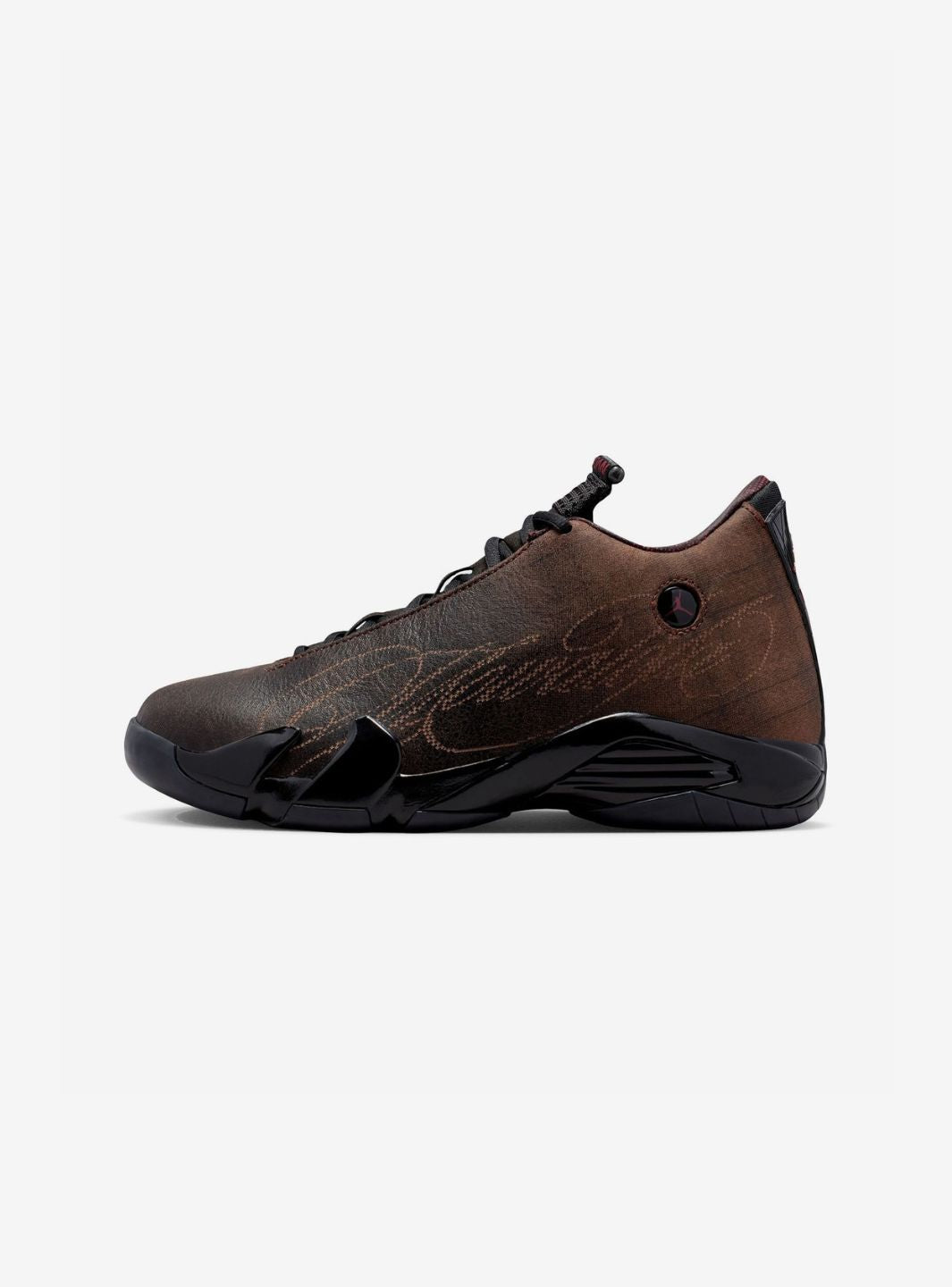


Air Jordan 14: history, design and sneaker culture
The Air Jordan 14 debuted in 1998 as the fourteenth generation of the line developed around Michael Jordan. Designed by Tinker Hatfield, it holds a special place in the brand's history because it is associated with one of the last and most iconic moments of Jordan's career with the Chicago Bulls.
Within the Air Jordan family, the AJ14 arrives after the Air Jordan 13 and changes its language once again, abandoning the organic shapes of the previous generation for a lower and more tapered construction.
The design takes inspiration from the world of sports cars and combines aerodynamic lines, technical details and a distinctive lateral Jumpman logo that recalls the aesthetic of automotive emblems.
Air Jordan 14 and Michael Jordan's Last Shot
The Air Jordan 14 is closely linked to the 1998 NBA Finals.
Tinker Hatfield had given Michael Jordan a prototype of the new sneaker before its official release. Jordan liked the model enough to wear it during the Finals, immediately helping to make it an important part of Air Jordan history.
The AJ14 is thus associated with the famous Last Shot, the basket made by Michael Jordan against the Utah Jazz during Game 6 of the 1998 Finals.
That victory gave the Chicago Bulls their sixth NBA title of the Jordan era and made the silhouette worn at that moment one of the sneakers most tied to a single episode of his career.
The Jordan 14 therefore does not just represent the next generation of the line: it symbolically coincides with the conclusion of Michael Jordan's last season with Chicago.
Tinker Hatfield and the sports car-inspired design
One of the most distinctive aspects of the Air Jordan 14 is its relationship with the automotive world.
Tinker Hatfield developed the silhouette by taking inspiration from luxury sports cars, transforming some characteristics of that language into elements of the sneaker.
The lines of the upper take on an aerodynamic profile, while the small Jumpman badge positioned on the side deliberately recalls the shape of a car emblem.
Air intakes, the low-profile structure and sole details also contribute to reinforcing the concept of speed.
However, the inspiration does not turn the AJ14 into a simple aesthetic exercise: the model uses technologies designed for performance and control, creating a concrete link between the idea of a sports car and that of a basketball sneaker.
Technology and construction of the Air Jordan 14
The Jordan 14 was developed with a relatively low construction compared to some of the previous generations.
Nike integrated two Zoom Air units, designed to offer responsiveness during movement, together with a structure designed to combine speed and control.
The sole also features ventilation elements and a construction that contributes to the silhouette's characteristic technical look.
These details allow the AJ14 to distinguish itself from both the Jordan 13 that preceded it and the Air Jordans of the early nineties.
The result is a sneaker that reflects the period in which it was born: a highly technical design, but at the same time built around a premium and recognizable aesthetic.
Air Jordan 14 Retro
The Air Jordan 14 Retro are the subsequent reissues of the silhouette born in 1998.
As with other Jordan generations, the term Retro does not identify a different model. Instead, it indicates a new production of the Jordan 14 made in the years following its debut.
An AJ14 Retro can bring a historic colorway back to the market or use the original structure to introduce a new interpretation.
Materials, shape, branding, colors and small details can change from one production to another. For this reason, the release year, full name and product code remain important when comparing different Air Jordan 14s.
Air Jordan 14 Black Toe
The Black Toe is one of the configurations most associated with the history of the Air Jordan 14.
The colorway uses a predominantly white upper accompanied by a black front area and red details, creating a combination closely linked to the colors of the Chicago Bulls.
The Air Jordan 14 Retro Black Toe 2024 brings this configuration back into the contemporary catalog.
The contrast between the white base and the black toe particularly highlights the tapered profile of the silhouette and the lateral Jumpman badge.
Black Toe represents the more historic side of the AJ14 well: a sneaker deeply connected to the final phase of Michael Jordan's career with Chicago.
Air Jordan 14 Ferrari
The Air Jordan 14 Ferrari takes one of the concepts already present in the original design of the silhouette to the extreme.
If the AJ14 was born from inspiration for sports cars, the Ferrari uses a palette and construction that make that reference even more evident.
The red upper immediately recalls the world of Italian sports cars, while black and yellow details further strengthen the association.
The Air Jordan 14 Retro Ferrari 2025 represents the contemporary return of this interpretation of the silhouette.
The Ferrari is therefore particularly consistent with the Jordan 14 because it does not simply apply a new colorway to the sneaker: it amplifies one of the concepts that contributed to the very birth of the model.
Air Jordan 14 Black University Blue
The Black University Blue uses a very different construction compared to the Black Toe or Ferrari.
The dark base makes the University Blue details more evident and allows the lateral Jumpman badge to emerge within a predominantly black configuration.
The Air Jordan 14 Retro Black University Blue 2026 shows how Jordan Brand continues to use the silhouette for new colorways even decades after the original debut.
Releases of this type expand the AJ14 archive without modifying the fundamental elements of the design: low profile, aerodynamic shapes and references to the automotive world remain clearly recognizable.
Aleali May and Air Jordan 14 Fortune
The collaboration with Aleali May moves the Air Jordan 14 toward a language much more tied to contemporary fashion.
The Air Jordan 14 Retro Aleali May Fortune uses different shades and materials compared to the classic configurations tied to the silhouette's sporting history.
The project demonstrates how much the Jordan 14 can be reinterpreted without losing its characteristic proportions.
It is also an important example of the expansion of the AJ14 beyond traditional basketball colorways: the silhouette becomes a base through which to develop different collaborations, materials and cultural references.
CLOT and Air Jordan 14 Low
The collaboration with CLOT instead uses the low variant of the silhouette.
The Air Jordan 14 Retro Low CLOT Terra Blush modifies the proportions around the ankle while maintaining several recognizable elements of the AJ14 family.
Colors, materials and dedicated details allow the collaboration to develop its own identity without erasing the relationship with the original model.
The presence of a Jordan 14 Low also shows that the history of the silhouette is not limited to a single high-cut or mid-cut construction: over the years, Jordan Brand has also used lower variants to explore new interpretations.
Men's and women's Air Jordan 14
The Jordan 14 for men and women are produced through different releases and size ranges.
Most of the historic configurations were born within the men's basketball world, while over time Jordan Brand has also developed Women's releases, collaborations and versions available in different sizing.
The Aleali May Fortune, for example, belongs to a different context than a Black Toe or a Ferrari, despite sharing the same basic silhouette.
The classification of the release can influence the size range, but does not necessarily modify the fundamental elements of the Air Jordan 14.
To correctly identify a model, therefore, the full name, year, colorway and product code remain important.
Original Air Jordan 14 and authenticity
The presence of historic Retros, new colorways and collaborations makes it important to correctly distinguish each original Air Jordan 14.
The shape of the upper, the lateral Jumpman badge, materials, stitching, sole, labels, product codes and packaging can change significantly between a Black Toe, a Ferrari, an Aleali May or a CLOT collaboration.
The comparison must therefore always be carried out with respect to the specific release and its related year of production.
At ResellZone, every product undergoes the verification process designed to check its authenticity and correspondence with the specific release. The method used is detailed on the page dedicated to product authenticity.