The Air Jordan 3 BIN 23 is not just a new colorway applied to one of the most beloved silhouettes in the history of Jordan Brand. It is the intersection of two legendary worlds: that of the Air Jordan 3, the shoe that in 1988 helped change the destiny of the line signed by Michael Jordan, and that of the BIN 23 collection, created in 2010 to transform select Air Jordans into authentic luxury objects.
The new release incorporates all the elements that made the Premio series special: refined materials, sophisticated tones, extremely limited production, exclusive packaging, and the famous red BIN 23 seal. For the first time, this treatment is officially applied to the Air Jordan 3, creating a sneaker designed not only to be worn, but also to be preserved as part of a collection.
With a run of just 2,300 pairs, an upper dominated by Team Red and Burgundy Crush, and numerous details inspired by the world of wine reserves, the Air Jordan 3 BIN 23 has immediately become one of the most talked-about releases of 2026. For many enthusiasts, it already possesses all the characteristics necessary to compete for the title of sneaker of the year.
The history of the Air Jordan 3: the sneaker that changed everything
To understand the importance of this release, one must start with the history of the Air Jordan 3. The silhouette was introduced in 1988, at one of the most delicate moments in the relationship between Michael Jordan and Nike. The athlete's contract was approaching a decisive phase, and the brand needed to create a sneaker capable of convincing him to continue the journey started just a few years earlier.
Responsibility for the project was entrusted to Tinker Hatfield, a designer destined to become one of the most important figures in Nike history. Hatfield abandoned the high-cut structure of the first two Air Jordans and developed a lighter, more dynamic, and modern shoe, capable of better supporting Michael's style of play.
The Air Jordan 3 introduced several elements that would become fundamental to the entire line. It was the first Jordan to feature the Jumpman on the tongue, it introduced the visible Air unit in the heel, and it made the elephant print famous—a pattern that still allows the silhouette to be recognized immediately today.
The advertising campaign also helped build the legend. The character of Mars Blackmon, played by Spike Lee, helped definitively link basketball, entertainment, fashion, and urban culture. The sneaker was presented not just as technical footwear, but as part of Michael Jordan's identity.
The Air Jordan 3 also accompanied the athlete during one of the most spectacular phases of his early career. The model is linked to the famous free-throw line dunk during the 1988 Slam Dunk Contest and to a season in which Jordan earned essential individual accolades.
For this reason, the AJ3 is not simply one of the many models in the Jordan archive. It is the sneaker that helped consolidate the relationship between Michael and Nike, defining an aesthetic language destined to influence all subsequent silhouettes.
From the White Cement to the Black Cement: the birth of an icon
The original colorways of the Air Jordan 3 have become some of the most important references in collecting. The White Cement and Black Cement still represent the most authentic face of the silhouette today, thanks to the combination of leather, red details, elephant print, and Nike Air branding.
Over the years, Jordan Brand has re-proposed the AJ3 through numerous retro versions, collaborations, and special interpretations. Some have faithfully respected the original builds, while others have experimented with new materials, colors, and storytelling.
Despite this long history, the silhouette had never officially entered the BIN 23 collection. The 2026 release therefore takes on special value: it is not just a new premium Jordan 3, but the first to receive one of the most exclusive treatments ever developed by Jordan Brand.
The birth of the Jordan BIN 23 collection
The history of the BIN 23 collection, also known as the Premio series, began in 2010. During that period, the concept of luxury sneakers was not yet as widespread as it is today. Collaborations between sports brands and high-fashion houses were less frequent, and most Air Jordans were still interpreted primarily as sports or retro products.
Jordan Brand decided to create a line intended for a different segment of enthusiasts. The goal was to select historical silhouettes and transform them into ultra-premium versions through better leathers, more refined craftsmanship, elaborate packaging, and much lower quantities than normal releases.
The original collection involved models such as the Air Jordan 2, Air Jordan 5, Air Jordan 7, Air Jordan 9, and Air Jordan 13. Each release had its own color identity, but all were united by the same language: superior quality materials, numbered pairs, and an almost artisanal attention to detail.
The BIN 23s were not intended as simple limited colorways. They were meant to represent a sort of private reserve of the Jordan archive, intended for collectors capable of understanding their historical and material value.

Why is it called BIN 23?
The name BIN 23 directly references the world of cellars and fine wines. The term “bin” is used to indicate a space, a lot, or a selection in which products considered particularly important are kept. The number 23, naturally, is a reference to the number worn by Michael Jordan.
Jordan Brand transferred this imagery to sneakers, presenting the series as a special selection kept separate from the rest of the production. The BIN 23s were the rarest bottles in the Jordan cellar: products made in limited quantities and intended to mature over time, even from a collector's perspective.
The most recognizable symbol of the collection became the red stamp resembling a wax seal. The detail recalls the marks used on bottles, documents, and high-end packaging, immediately communicating that the sneaker belongs to a different category than normal releases.
It is therefore not a simple decorative logo. The seal represents a visual certification: without that symbol, we would have a premium Air Jordan; with the symbol, we are officially dealing with a BIN 23.
The Premio series anticipated the luxury sneaker market
When the first BIN 23 collection hit the market, the concept of luxury applied to sneakers was still in its development phase. Jordan Brand had intuited that a portion of enthusiasts were not looking just for a shoe linked to Michael Jordan's performance, but desired to own a product that was more sophisticated and mature.
The BIN 23s anticipated many elements that became common in subsequent years: individual numbering, the use of premium materials, special packaging, dedicated accessories, and communication built around quality rather than simple nostalgia.
The series managed to keep the sporting identity of the Jordan silhouettes intact, but shifted them into a territory closer to collecting and luxury craftsmanship. There was no need to add the name of an international fashion house: the value arose directly from the history of the model and the quality of its reinterpretation.
After the 2010 and 2011 releases, the collection was discontinued. This very short duration contributed to increasing the allure of the original shoes, which became progressively more difficult to find complete and in good condition.
The return of the BIN 23 collection in 2026
After more than fifteen years, Jordan Brand has decided to officially reopen the BIN 23 chapter. The return of the line immediately reignited the interest of collectors who remembered the original series and of a new generation accustomed to seeing sneakers as true luxury products.
Within this new program, the Air Jordan 3 occupies a central position. It is, in fact, the first time the silhouette designed by Tinker Hatfield has been admitted into the Premio family.
The choice seems almost inevitable. The Jordan 3 possesses a fundamental history, a construction already rich in iconic details, and a structure capable of enhancing different materials. The BIN 23 treatment does not attempt to overturn it but brings its most recognizable elements to the highest level.

The design of the Air Jordan 3 BIN 23
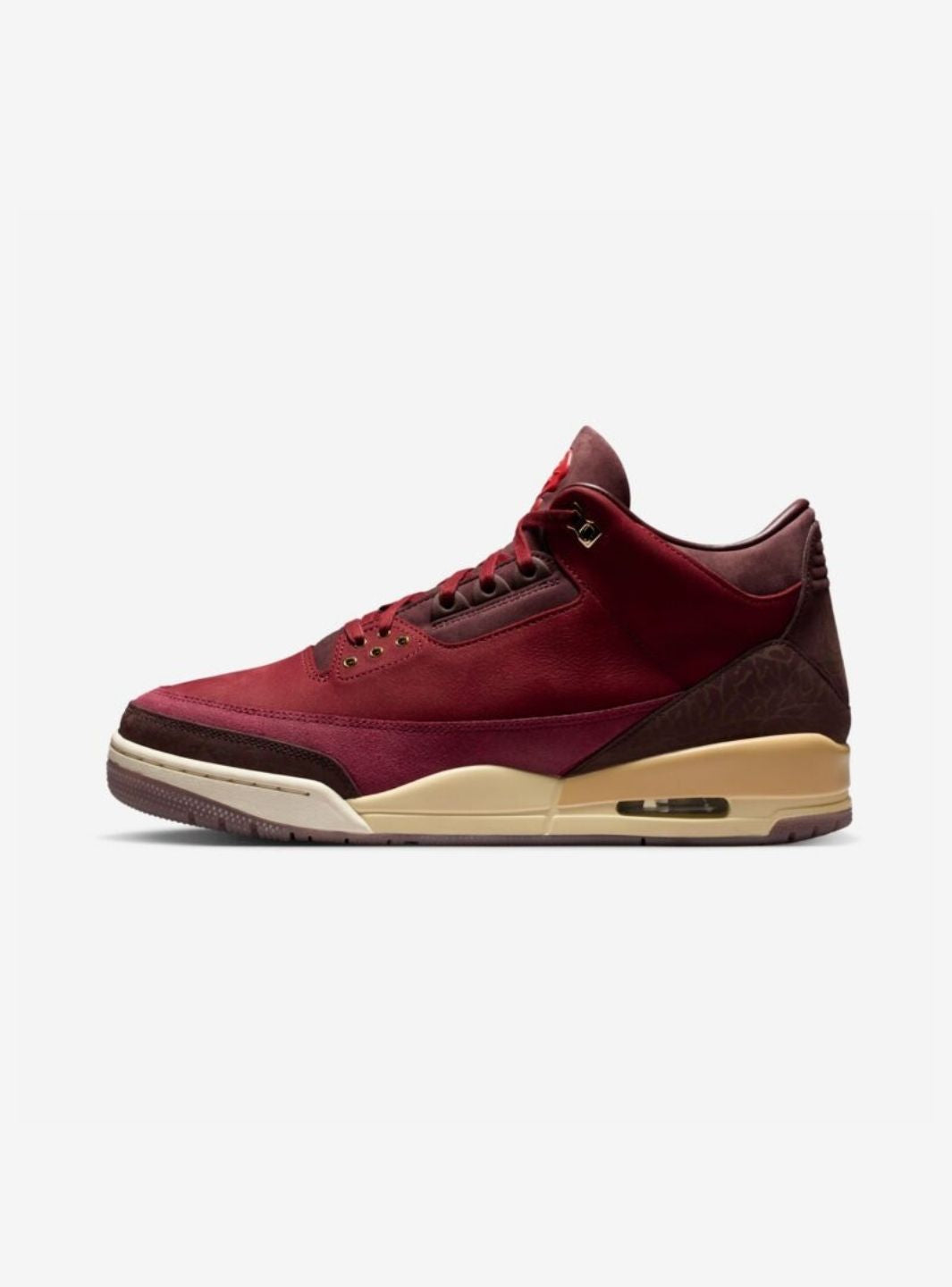
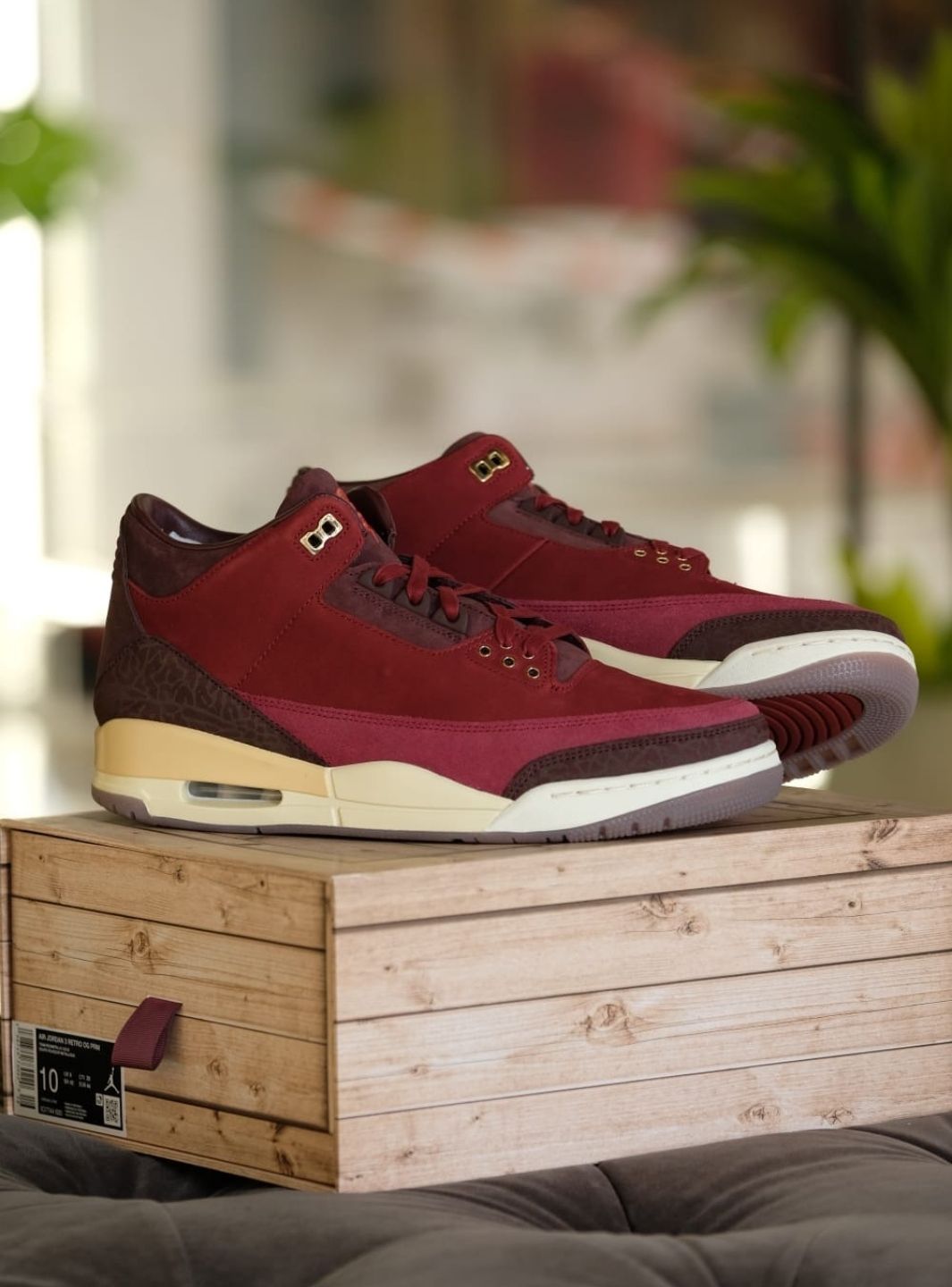
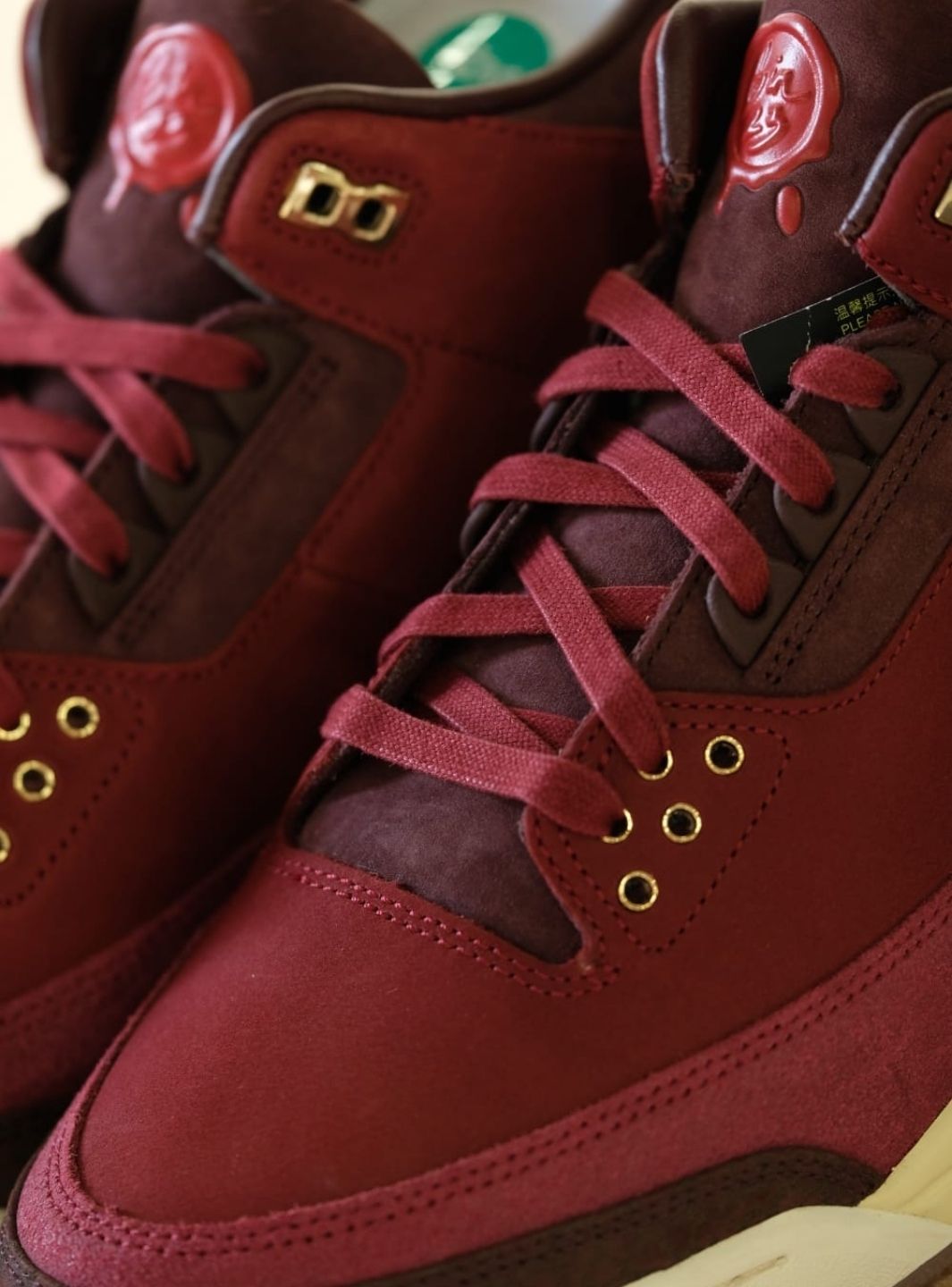
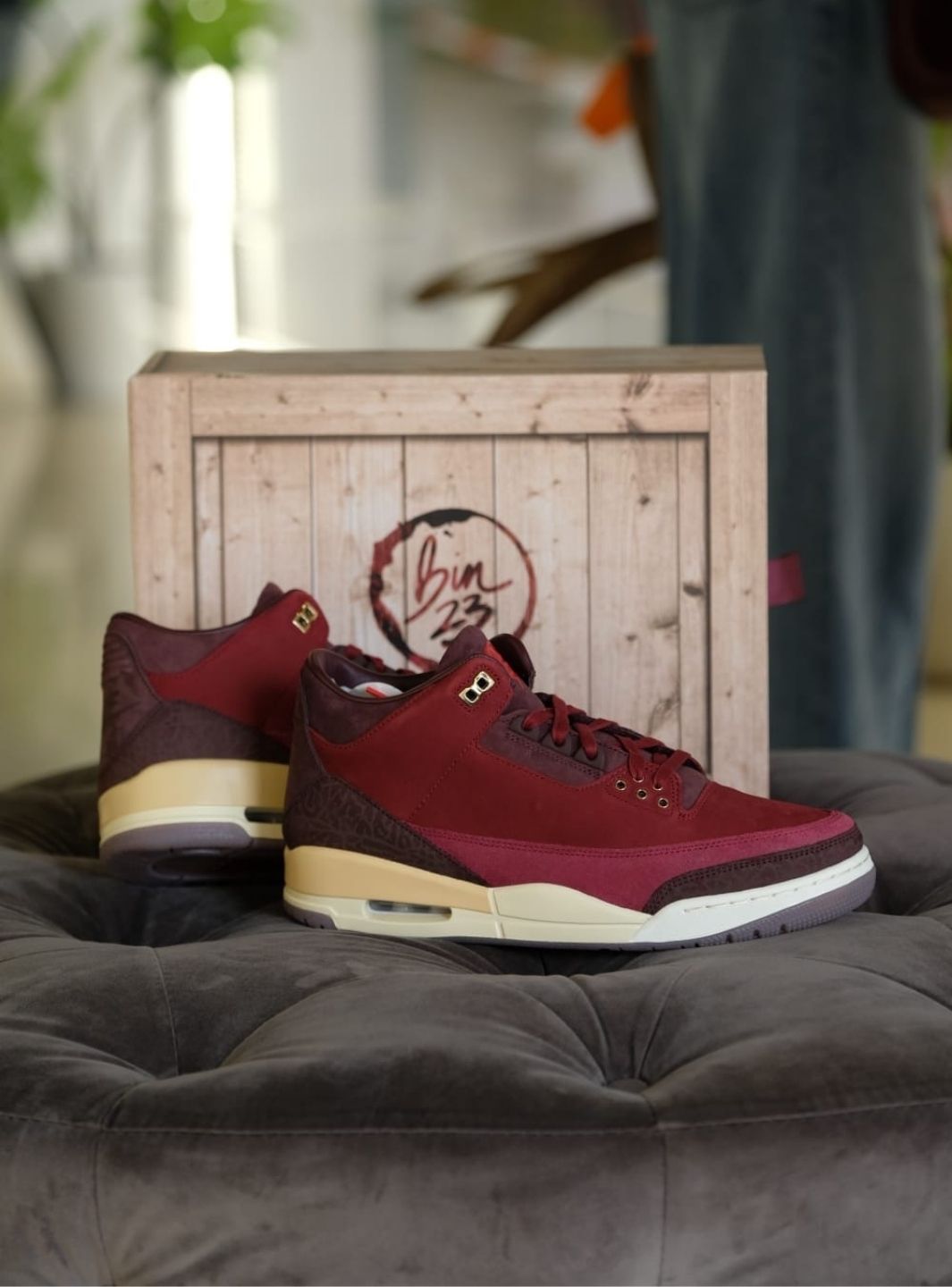
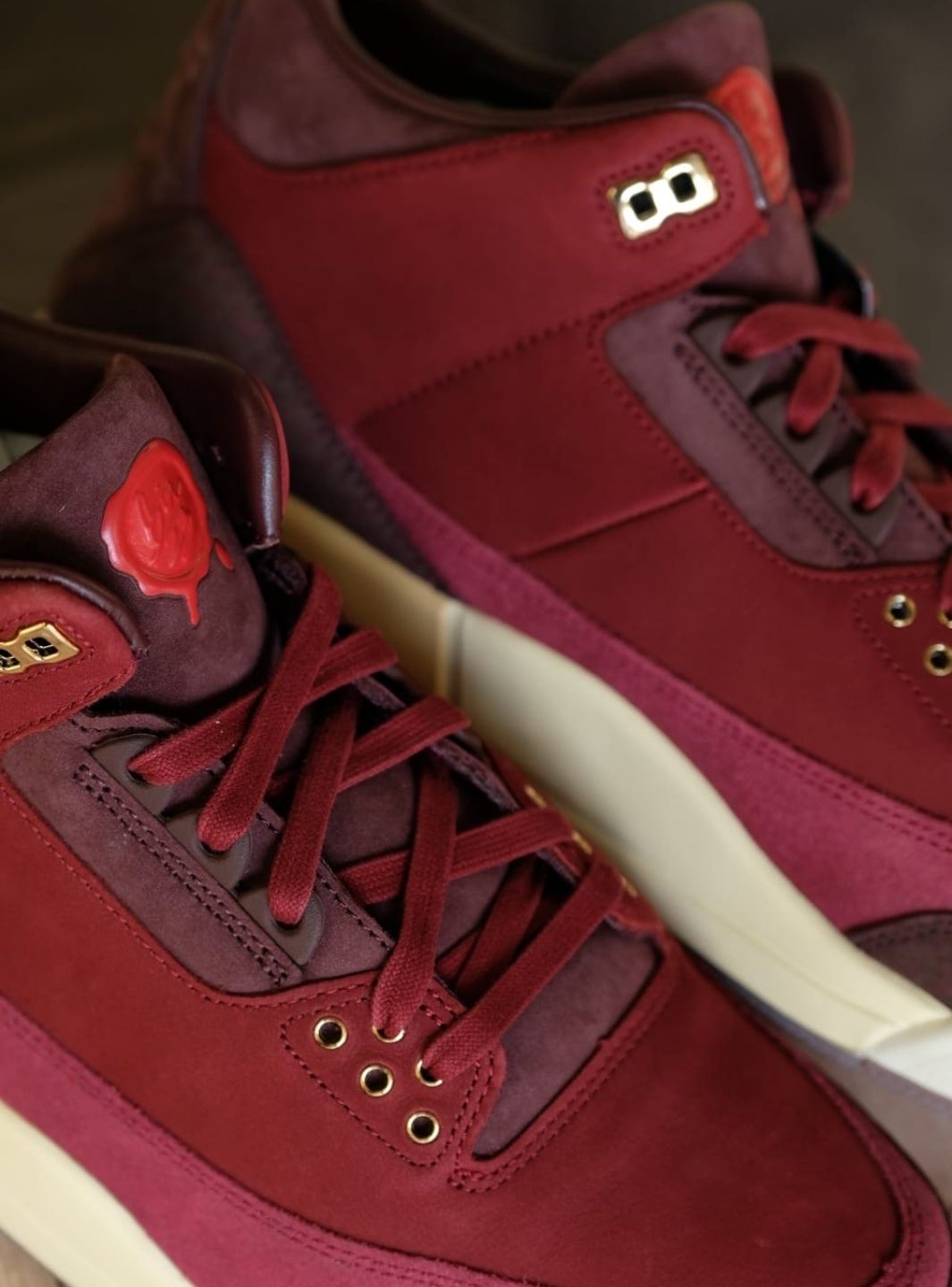
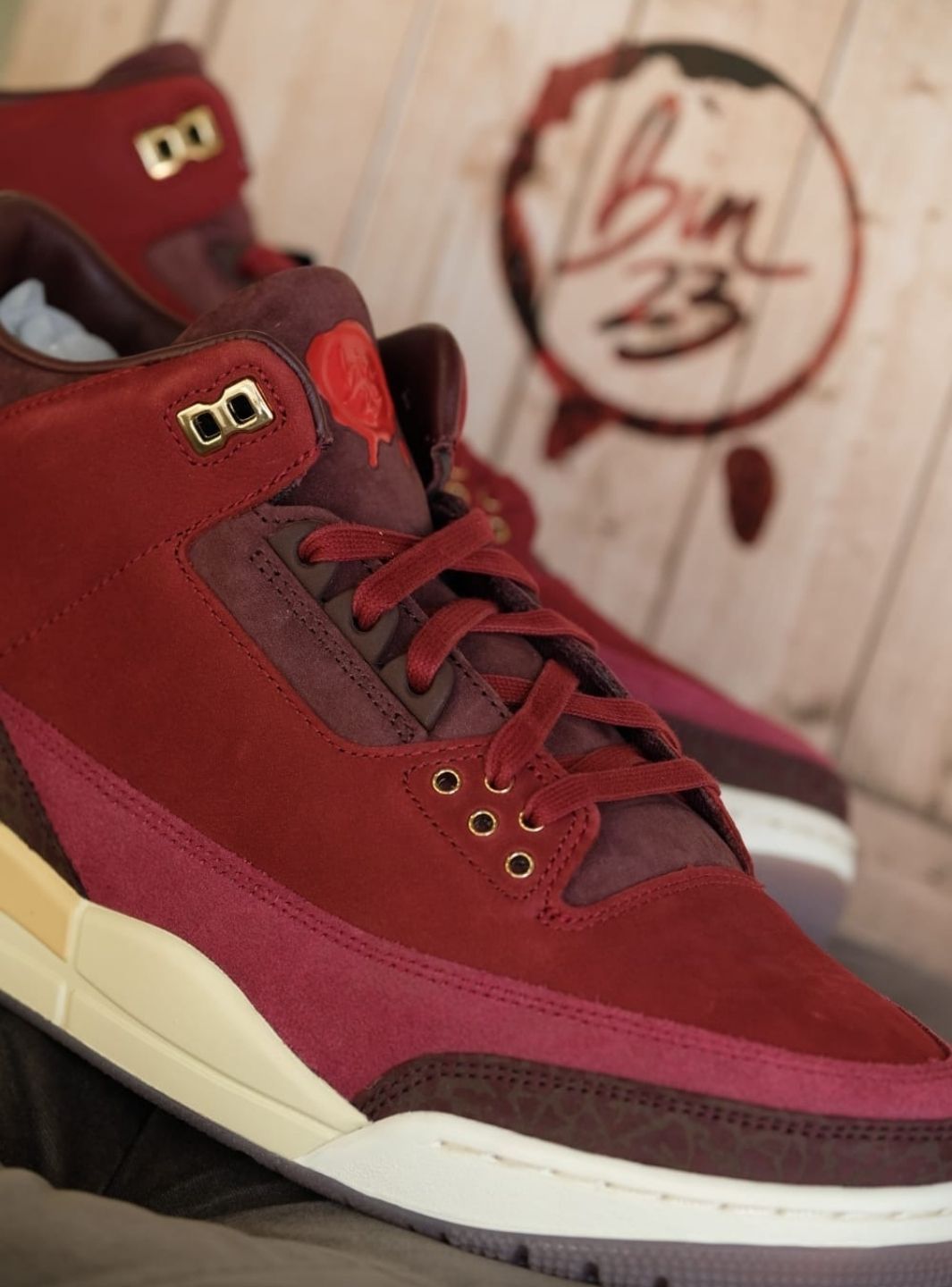
The Air Jordan 3 BIN 23 uses an elegant and deep palette, dominated by Team Red and Burgundy Crush tones. The reference to the world of wine is immediate: the upper recalls the color of the finest bottles, barrels, and reserves kept for years before being opened.
The premium construction enhances the various shades of the surface. Depending on the lighting, some areas appear closer to dark red, while others take on burgundy and purplish hues. It is a sneaker that changes its appearance when observed up close and that relies more on the depth of the materials than on particularly loud contrasts.
The elephant print remains present on the toe and around the heel, but is offered in a tone-on-tone version. Instead of using the traditional gray with black lines, Jordan Brand chooses a print coordinated with the upper, making the result more refined and coherent.
The Air Jordan 3 therefore remains immediately recognizable, but its language becomes more mature. Every historical code is preserved and reinterpreted through the BIN 23 philosophy.

Metallic Gold details and Coconut Milk midsole
The Metallic Gold accents on the eyelets add small points of light to the construction. The gold does not dominate the design and does not turn the sneaker into an overly flashy product. It is used with care, like a precious detail visible especially when the shoe is viewed up close.
The Coconut Milk midsole introduces a slightly vintage cream tone instead. The choice avoids the sharp contrast of a completely white midsole and contributes to strengthening the narrative of a sneaker inspired by a product stored and matured over time.
Completing the construction is a translucent Smokey Mauve outsole, capable of picking up the burgundy tones without directly copying them. Thus, even the bottom of the sneaker becomes part of the storytelling, instead of functioning as a simple technical base.
The return of the Nike Air branding
On the heel of the Air Jordan 3 BIN 23 appears the famous Nike Air, one of the details most appreciated by collectors of the silhouette. The branding directly recalls the original 1988 builds and strengthens the bond with the model's history.
In a release built around exclusivity and premium materials, the Nike Air performs an important function: it reminds us that the shoe was not born as an independent luxury product, but as an evolution of one of the most important basketball sneakers ever.
The balance between past and present is one of the strengths of the entire project. The BIN 23 adds value and refinement, but without eliminating the elements that made the Air Jordan 3 an icon.
The red seal on the tongue
The decisive detail is naturally the BIN 23 wax stamp positioned on the tongue. The red seal picks up the one used on the original releases of the collection and allows the sneaker's membership in the Premio series to be recognized immediately.
It is a relatively small element, but it completely changes the perception of the model. The symbol connects the Air Jordan 3 to the 2010 and 2011 releases, transforming it into the new chapter of a story that remained suspended for over fifteen years.
To a casual observer, it might appear as a simple graphic detail. For a Jordan collector, however, it represents a signature, a certificate, and a declaration of exclusivity.
Packaging designed as part of the sneaker
The BIN 23 philosophy is not just about the shoe. The packaging is also developed as an integral part of the experience and helps distinguish the release from normal Jordan retros.
The Air Jordan 3 BIN 23 is accompanied by collector's accessories such as cedar shoe trees, a dust bag, and a dedicated retro card. The shoe trees help preserve the shape of the sneaker, while the dust bag protects the more delicate materials of the upper.
The packaging recalls the imagery of wine crates, humidors, and objects designed to be kept with care. Opening the box thus becomes part of the narrative, exactly as it happens with a high-end product.
For those who purchase the sneaker for collection purposes, keeping the packaging and accessories intact is particularly important. A complete BIN 23 inevitably possesses greater cultural and commercial value than a pair lacking the original set.
Only 2,300 pairs: extremely limited production
One of the elements that made the Air Jordan 3 BIN 23 immediately desirable is the production indicated at just 2,300 pairs. A very low number when compared to the global demand for an important silhouette like the Jordan 3.
It is not, therefore, a release defined as limited just to fuel hype. With thousands of interested collectors in every part of the world, a run of this type makes the chance of retail purchase extremely low.
The numbering further contributes to the allure of the project. Each pair becomes an identifiable part of a closed and unrepeatable production. Some numbers, such as 23 or the first units produced, can take on even greater value for the most demanding collectors.
Rarity, however, does not represent the only reason for success. A sneaker produced in few units does not automatically become important. In the case of the Air Jordan 3 BIN 23, the scarcity accompanies a true story, an iconic silhouette, and a level of construction consistent with the positioning.
Why it is a candidate for the title of sneaker of the year
The Air Jordan 3 BIN 23 possesses almost all the elements that define a memorable release. It brings back to life a collection loved by collectors, introduces the AJ3 to the Premio series for the first time, and uses materials capable of clearly distinguishing it from a normal retro version.
In a market crowded with collaborations, reissues, and continuous drops, this sneaker manages to emerge because it does not seem built solely around the hype of the moment. Its importance arises from the Jordan archive and the ability to connect different eras.
The silhouette dates back to 1988. The BIN 23 collection was born in 2010. The new interpretation arrives in 2026. Three different moments are brought together within the same project, creating a sneaker that can be fully understood only by knowing the history it carries with it.
It is a release that speaks to Jordan 3 enthusiasts, collectors of the first Premios, and those who today seek truly exclusive products. It is not just beautiful or rare: it holds a precise position in the evolution of the brand.
A sneaker built to last beyond the hype
Many releases generate enormous attention in the days leading up to the launch and are quickly replaced by the next sneaker. The Air Jordan 3 BIN 23, however, seems designed to maintain its cultural value over time.
Being the first Jordan 3 in the collection is a milestone that cannot be replicated. Even if Jordan Brand were to propose other AJ3 BIN 23s in the future, this release would remain the model that officially inaugurated the relationship between the silhouette and the Premio line.
Its relevance does not depend on a collaboration with a current artist or a campaign destined to fizzle out. It depends on the Jordan history, the materials, the quantity produced, and the position the shoe occupies within the archive.
Secondary market prices may change and hype may decrease, but the historical value of the first Air Jordan 3 BIN 23 will remain intact.
Wear it or keep it as a collector's item?
A sneaker produced in just 2,300 pairs inevitably generates a dilemma: wear it or keep it? In the case of the BIN 23, both choices can be considered correct.
The richness of the materials and tones makes the shoe particularly interesting on the feet. The suede can develop variations and signs over time capable of giving personality to the pair. At the same time, the numbering, packaging, and dedicated accessories drive many owners to treat it as an archival object.
For those who choose to keep it, it is essential to keep the box, dust bag, shoe trees, and retro card intact. In premium collecting, the completeness of the set significantly affects interest and future valuation.
Reducing the Air Jordan 3 BIN 23 to a mere investment, however, would be limiting. At its core, it remains a sneaker born from basketball heritage and designed to be worn. The final choice depends on the personal relationship each collector builds with their own pair.
The Air Jordan 3 BIN 23 is already a piece of history
The Air Jordan 3 BIN 23 represents one of the most successful intersections of history, luxury, and collectibility. It takes a fundamental 1988 silhouette and places it within a line that, as early as 2010, had anticipated the future of premium sneakers.
The Team Red and Burgundy Crush upper, the tonal elephant print, the Metallic Gold accents, the Coconut Milk midsole, and the red wax seal create an elegant and instantly recognizable sneaker. The dedicated packaging and the limited production of 2,300 pairs complete a project designed to occupy a precise place in the Jordan archive.
Determining once and for all which sneaker will be the one of the year will take time. But this Jordan 3 already possesses everything needed to be remembered as one of the most important releases of 2026.
Because some Jordans are bought to follow a trend. Others are cherished because they tell a piece of history. The Air Jordan 3 BIN 23 undoubtedly belongs to the second category.
Discover the most sought-after Air Jordans on ResellZone
On ResellZone you will find the most desired Jordan releases, from new drops to rare models that have marked the history of sneaker culture. Each product is selected not only for its market value, but also for the history, materials, and cultural significance it carries.
Stay updated on our website and app to discover upcoming releases, delve into the most exclusive models, and find the sneakers destined to become the new grails of collecting.
The best releases don't stay available for long. The most important stories, however, continue to grow over time.