Virgil Abloh: The Codes brought one of the most important creative archives of contemporary fashion and sneaker culture to the Grand Palais in Paris. From September 30 to October 9, 2025, the Virgil Abloh Archive™, in partnership with Nike, recounted nearly twenty years of the designer’s work through prototypes, sketches, objects, images, footwear, fashion, music, and architecture.
This was not simply an exhibition dedicated to sneakers. The Codes sought to explain the method by which Virgil Abloh transformed familiar objects through small interventions, symbols, and visual rules capable of making them immediately recognizable.
At the center of the exhibition was, naturally, his relationship with Nike: from the revolution of The Ten to the Air Force 1, Jordan, Dunk, and other projects that profoundly changed the way we conceive of a sneaker collaboration.
Virgil Abloh: who was the designer who changed fashion and sneaker culture
Virgil Abloh, born in 1980 and passed away in 2021, built a career that is difficult to encapsulate in a single definition.
Trained as a civil engineer and later in architecture, he worked across fashion, music, art, design, furniture, footwear, and creative direction. In 2012, he founded Pyrex Vision and the following year launched Off-White, a brand with which he developed a language capable of connecting streetwear and high fashion.
In 2018, he was also appointed artistic director of Louis Vuitton's menswear line, becoming one of the most influential figures in contemporary fashion.
But a fundamental part of his legacy stems from sneakers and the relationship he built with Nike.
Abloh did not just choose new colors. He visually disassembled objects, made the production process visible, and used normally hidden details as part of the design.

What does Virgil Abloh’s “The Codes” mean?
The title of the exhibition is not accidental.
The “Codes” were the principles and signs through which Virgil built his creative language. Seemingly simple elements could be applied to a sneaker, a garment, a piece of furniture, a space, or a graphic project while maintaining the same logic.
Quotation marks, industrial lettering, visible components, exposed stitching, zip ties, colors used as signage, and small shifts from the original object became design tools.
One of the best-known ideas associated with Abloh was to modify an existing object just enough to change its perception. It was not necessarily required to create something from scratch: it could be enough to intervene on certain fundamental codes to attribute a new meaning to it.
It is precisely this method that connects seemingly distant projects.
Virgil Abloh x Nike: the collaboration that changes everything
The relationship between Virgil Abloh and Nike reached its turning point in 2017.
The project is called The Ten and starts from a radical idea: take ten silhouettes belonging to Nike and Jordan history, visually disassemble them, and reconstruct them through Abloh’s language.
The ten original sneakers were:
- Air Jordan 1
- Nike Air Max 90
- Nike Air Presto
- Nike Air VaporMax
- Nike Blazer Mid
- Nike Air Force 1 Low
- Nike React Hyperdunk 2017
- Nike Zoom Fly
- Nike Air Max 97
- Converse Chuck Taylor All Star
The project is conceptually divided between “REVEALING” and “GHOSTING”: on one side, sneakers that are literally open and deconstructed, and on the other, translucent materials that allow one to observe elements normally hidden.
The Ten: why it became such an important collection
The Ten did not invent the concept of a sneaker collaboration, but it profoundly changed the way a collaboration could intervene in the product.
Virgil did not simply apply the Off-White logo onto a Nike.
On the Air Jordan 1, for example, the Swoosh seems almost detached from the upper, the stitching becomes part of the composition, and various components appear deliberately unfinished. The word “AIR” is printed directly on the midsole within quotation marks.
On other models, texts like “SHOELACES,” “FOAM,” and technical denominations that would normally remain invisible to the consumer were added.
Abloh thus transforms the industrial process itself into an aesthetic language.

After The Ten: all of Virgil Abloh’s Nikes and Jordans
The success of the 2017 project paved the way for a much longer collaboration.
In the following years, new Air Jordan 1s, Air Prestos, VaporMaxes, Blazers, Air Force 1s, Dunks, Air Jordan 2s, Air Jordan 5s, and numerous other models arrived.
Some sneakers became closely linked to cultural venues and institutions. This is the case for the Air Force 1s created for the Museum of Modern Art in New York, for the MCA in Chicago, for ICA Boston, and for other projects linked to the designer’s creative universe.
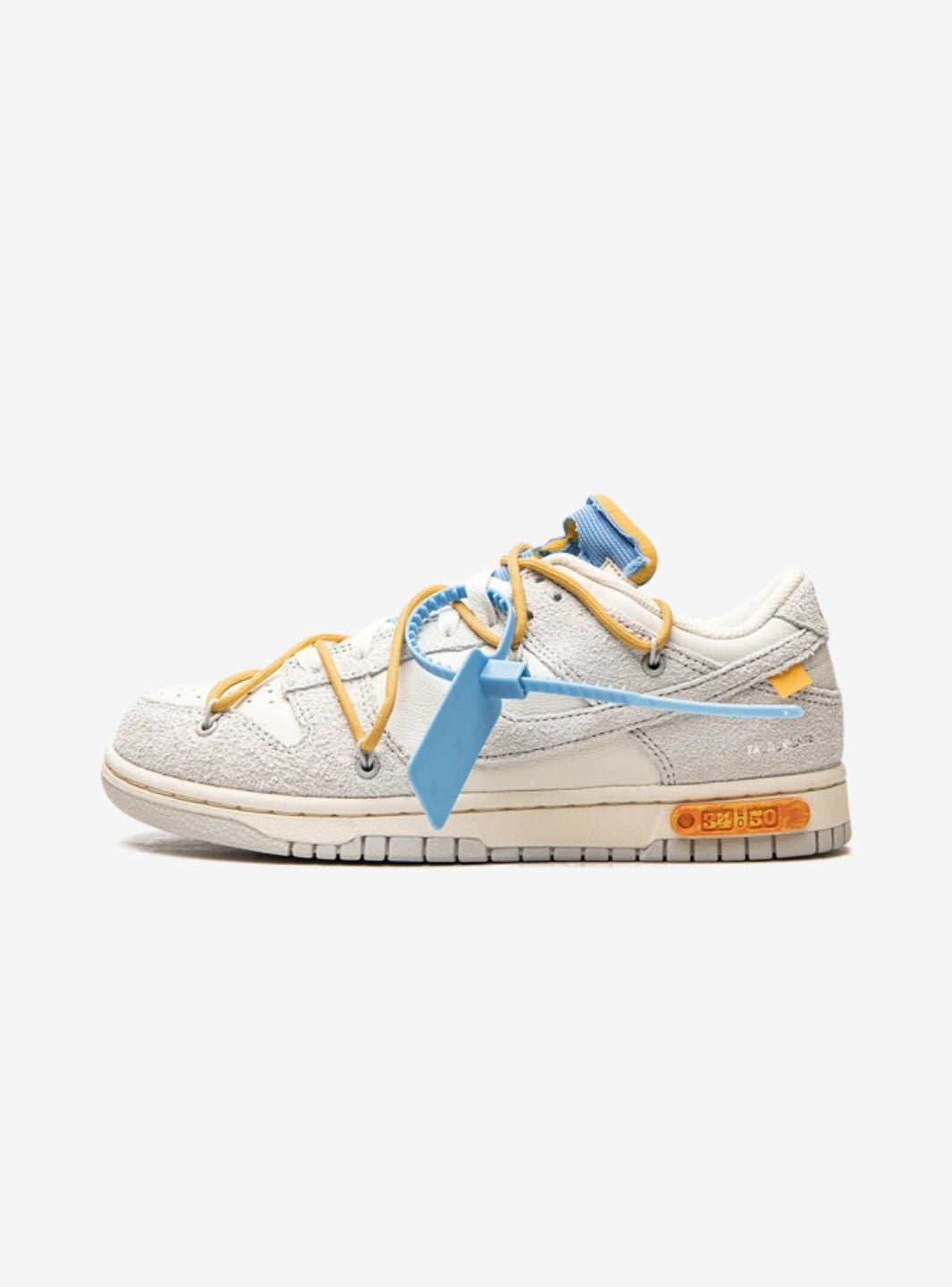
In 2021, The 50 arrived, a project composed of fifty Nike Dunk Lows in which small variations in materials and colors allowed for the creation of dozens of versions starting from the same structure.
Those who want to explore these releases can find various models in the Nike x Off-White selection on ResellZone.
Virgil Abloh: The Codes at the Grand Palais in Paris
The Paris exhibition opened on September 30, 2025, the day Virgil Abloh would have turned 45, and remained open to visitors at the Grand Palais until October 9.
It was the first major European exhibition exclusively dedicated to the work of Virgil Abloh and was born from the collaboration between the Virgil Abloh Archive™ and Nike, with the support of the Virgil Abloh Foundation.
The project was curated by Chloe Sultan and Mahfuz Sultan as an expanded version of the previous The Codes exhibition presented in 2022.
The starting point is impressive: the Virgil Abloh Archive comprises approximately 20,000 items including prototypes, sketches, images, objects, projects, and materials that belonged to the designer.
Therefore, the exhibition did not only display finished products. A fundamental part was dedicated precisely to the process: tests, ideas, prototypes, and objects that allowed one to observe how Abloh arrived from the initial concept to the final result.

20,000 pieces to tell the story of nearly twenty years of creativity
One of the most important characteristics of The Codes is the breadth of the narrative.
Reducing Virgil Abloh to his collaboration with Nike would indeed be impossible. The journey spanned nearly twenty years of production and showed how the same creative principles could continuously move between different disciplines.
Footwear, clothing, architecture, advertising, music, furniture, graphics, and personal objects were presented as parts of the same system.
This allowed for an understanding of a fundamental element of Virgil’s work: the medium could change, the method remained recognizable.
Fashion, music, architecture, and sneakers in the same archive
One of the most interesting aspects of Abloh’s career is precisely the absence of rigid boundaries.
Before becoming one of the most well-known designers in the world, he had studied engineering and architecture. Simultaneously, he worked in music, DJing, and creative direction.
Throughout his career, these worlds are never truly separated.
A fashion show can use logic derived from architecture. A sneaker can be treated as an industrial object to be analyzed. Packaging can become part of the project. A DJ set can enter the same ecosystem as a fashion collection.
The Codes showed how this contamination was not random, but one of the structural features of his work.
Nike inside The Codes: prototypes and creative process
The partnership with Nike inevitably occupied a central space within the exhibition.
In addition to the now-iconic sneakers, the path allowed for the observation of archival materials and prototypes that helped in understanding the process through which Virgil reinterpreted Nike models.
The difference is significant.
Seeing a retail sneaker allows you to observe the result. Seeing tests, samples, and intermediate ideas, however, allows you to understand how that result was built.
It is exactly the type of access that makes an archive particularly valuable for designers and creatives.
Workshops, conversations, DJ sets, and screenings
The Codes was not designed as a completely static exhibition.
During the opening days, the program included conversations, workshops, DJ sets, screenings, and meetings with figures belonging to the creative community built around Virgil.
Nike participated with in-depth looks at their long collaboration with Abloh and with meetings involving designers, athletes, and partners of the brand.
This participatory component was consistent with one of the central principles of his philosophy: making the creative process accessible and using his position to open doors for other people.
The return of Colette to the Grand Palais
During The Codes, another fundamental name in Parisian fashion culture also returned temporarily: Colette.
The historic concept store, which closed permanently in 2017, occupied the Rotonde Clemenceau of the Grand Palais with a special space linked to the exhibition.
The project offered products made by collaborators close to Virgil along with some particularly significant items, including a re-edition of the Virgil Abloh x Braun collaboration and the French translation of Larry Warsh’s book Abloh-isms.
This detail also tells us how much The Codes was intended as a reconstruction of the cultural ecosystem surrounding Abloh, and not just as a sequence of objects to observe.
Virgil Abloh and Jordan Brand
Within the Nike journey, the relationship with Jordan Brand naturally occupies a special role.
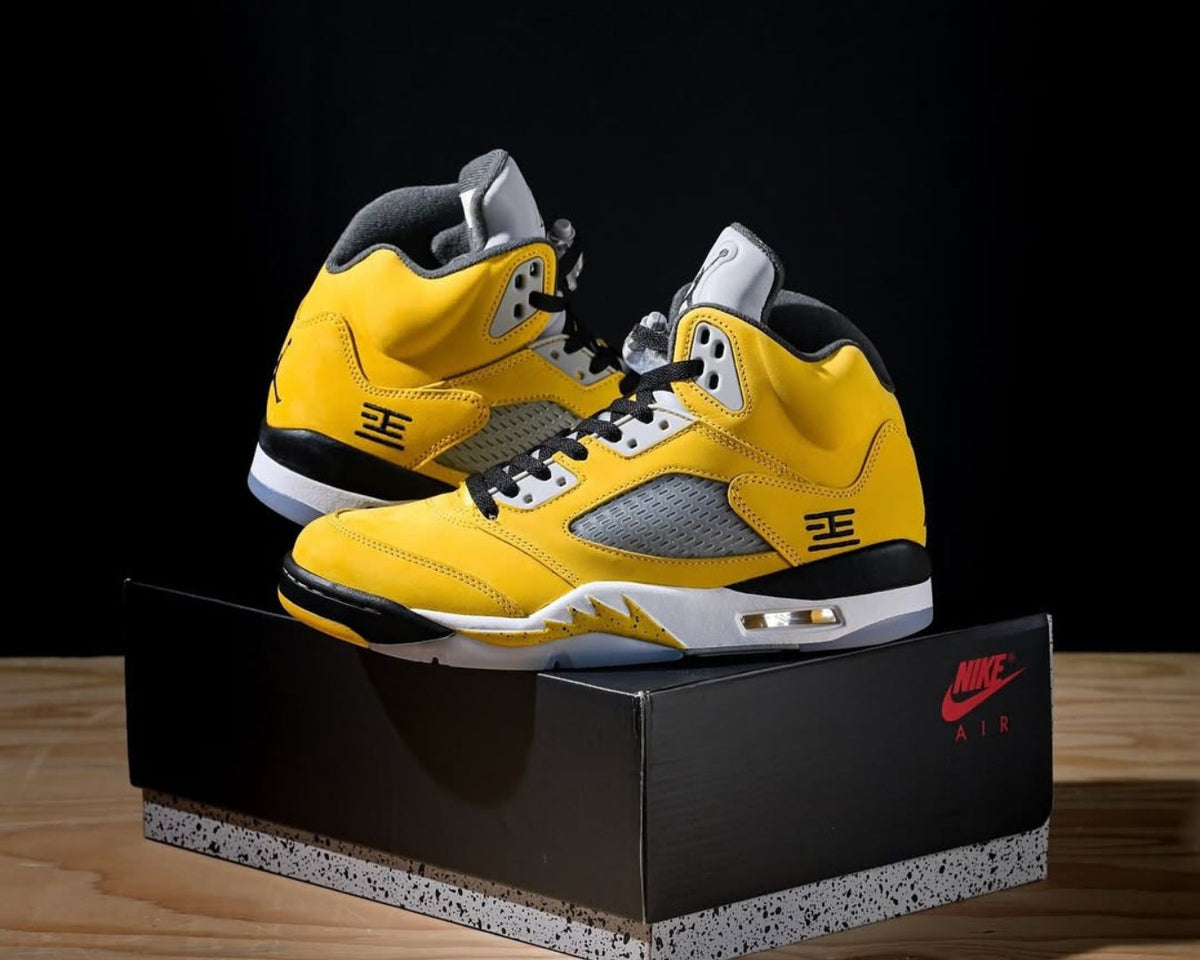
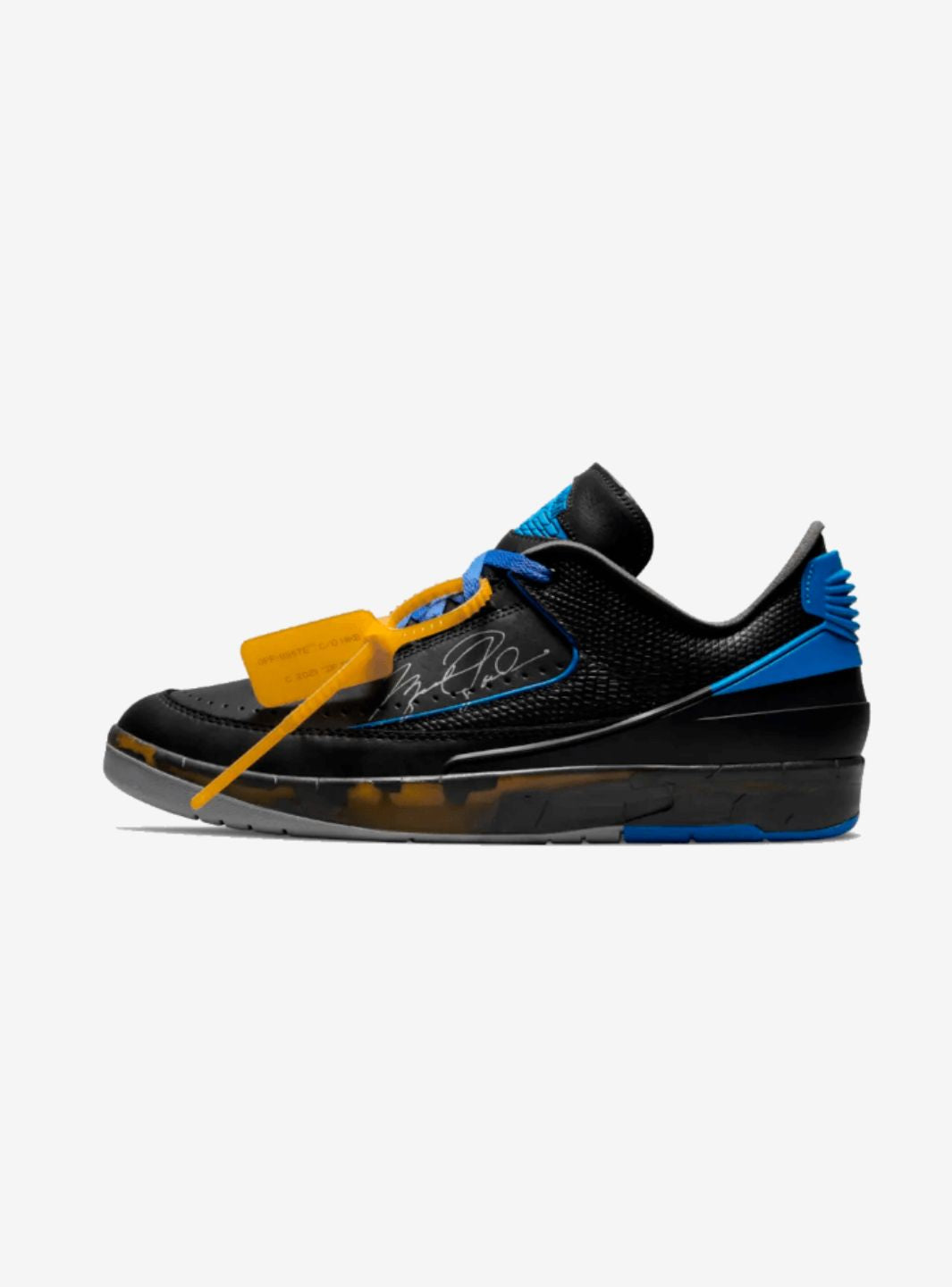
The 2017 Off-White x Air Jordan 1 “Chicago” became one of the symbolic sneakers of Abloh’s entire career. The European White version and the University Blue would follow, in addition to the reinterpretations of the Air Jordan 5 and Air Jordan 2.
Virgil had a very strong personal relationship with Jordans: they were sneakers that belonged to the culture he grew up with.
Deconstructing an Air Jordan 1, therefore, meant intervening on an object already charged with meaning, keeping its history recognizable while completely modifying the way it was read.
Why did zip ties, quotation marks, and lettering become so recognizable?
Many elements associated with Off-White and Nike collaborations work because they are extremely simple.
The zip tie, for example, is born as a very common industrial object. Placed on a sneaker, however, it becomes a foreign element that forces you to look at the object again.
The quotation marks do something similar. Writing “AIR” on a midsole that already contains an Air unit seems almost redundant, but that very redundancy transforms a technical feature into communication.
The same goes for “SHOELACES” printed on the laces.
Virgil makes explicit what would normally not need to be explained. It is one of the simplest and at the same time most effective mechanisms of his language.
Virgil Abloh’s 3% rule
One of the most cited concepts when talking about Virgil’s method is the so-called “3% rule”.
The idea, to simplify, is that modifying a small percentage of an existing object can be enough to produce something perceived as new.
The value of the concept does not lie in the mathematical percentage itself, but in the way it describes his creative approach.
Abloh did not always see originality as the need to erase what came before. He often preferred to dialogue with a known object, altering some of its codes to change its meaning.
The Ten is probably the most famous example of this philosophy applied to sneakers.
What remains of Virgil Abloh after The Codes
The Grand Palais exhibition had a particular value because it shifted the focus from the individual product to the complete creative process.
Virgil Abloh is often remembered through a few immediately recognizable images: Off-White, industrial belts, The Ten, Louis Vuitton, the Jordan 1, or the Air Force 1.
The archive shows, however, that behind those objects existed a much broader system made of study, collaborations, tests, references, and connections between disciplines.
And this is probably the most important part of his legacy.
Not just the sneakers he created, but the way he proved to a new generation that fashion, art, music, architecture, and street culture could use the same language and occupy the same space.
Why Virgil Abloh changed sneaker culture
Virgil’s impact on sneakers is not measured simply by the value reached by some models on the secondary market.
The most profound change concerns the way a collaboration is conceived.
After The Ten, it became much more common to see sneakers where the collaborator intervenes in the construction, recounts the process, modifies the packaging, and builds a narrative universe around the product.
Abloh showed that a sneaker already known to millions of people could be used as a canvas on which to discuss design, production, culture, and communication.
Virgil Abloh: The Codes had precisely this merit: to bring the focus back from individual grails to the method that generated them.
And perhaps this is the reason why, years after his passing, his work continues to be so present: products belong to a specific moment, but his codes continue to be used, reinterpreted, and discussed by those who design what comes next.