There are bags that become popular for a season and others that manage to span nearly a century without losing their recognizability. The Louis Vuitton Speedy belongs to the latter category.
Created in the 1930s as a compact travel bag under the name Express, the Speedy has accompanied Louis Vuitton's evolution from the world of trunks to contemporary fashion. In the 1960s, it definitively entered pop culture thanks to Audrey Hepburn, while decades later, collaborations with artists like Stephen Sprouse and Takashi Murakami completely transformed its image.
With Pharrell Williams and the new Speedy P9, the Louis Vuitton icon then entered another era: ultra-soft leather, vibrant colors, and a language that combines luxury, music, and street culture.
But how was the Speedy really born? What are the differences between the Speedy 25, 30, 35, 40, Nano, and Bandoulière? And why does it continue to be one of the most recognizable luxury bags in the world?
Louis Vuitton Speedy: the story begins in the 1930s
The story of the Speedy was born from the deepest DNA of Louis Vuitton: travel.
At the beginning of the twentieth century, the Maison was already known primarily for trunks and luggage designed to accompany a society that was increasingly traveling by train, automobile, and ship.
In the 1930s, Gaston-Louis Vuitton developed a bag that was more compact, soft, and practical than the Maison’s traditional rigid luggage.
The first name was Express, a direct reference to the speed and the new means of transport of the time.
The concept was simple but extremely modern: to create a bag that was lightweight, flexible, and compact enough to be used during daily travel.
The name was subsequently changed to Speedy, but the idea remained the same: a Louis Vuitton built for a life that was becoming ever faster.
From the Keepall to the Speedy
The Speedy shares many elements with the famous Keepall, another of Louis Vuitton's great travel icons.
Both use a soft structure, a rounded silhouette, and the characteristic Toron handles. The Speedy can be seen almost as a more compact and urban translation of the travel bag concept.
It is precisely this transition that is fundamental to the history of the Maison: the heritage built around great journeys is progressively adapted to daily life.
The same principle would accompany Louis Vuitton for decades and lead up to the Soft Trunk by Virgil Abloh, where the heritage of the trunk is again transformed into an object to be worn every day.
When was the Speedy Monogram born?
The Speedy we immediately imagine today when we hear the name Louis Vuitton is not exactly the one from the 1930s.
A fundamental step occurred in 1959, when Louis Vuitton developed a more flexible version of its canvas and reinterpreted the Speedy in the iconic Monogram.
The LV pattern with flowers and geometric symbols had already been created in 1896, but its application to soft bags opened a new phase in Louis Vuitton leather goods.
The Speedy Monogram thus became lighter, instantly recognizable, and much closer to the object we know today.

Audrey Hepburn and the birth of the Speedy 25
One of the most famous moments in the bag’s history came in the 1960s and is linked to Audrey Hepburn.
The actress was already a great admirer of the Speedy but wanted a smaller version, better suited to daily life and her proportions.
In 1965, Louis Vuitton therefore created a compact version for her: the Speedy 25 was born.
That format radically changed the perception of the bag.
The Speedy was no longer just a reduced version of a piece of travel luggage: it became a true city bag, elegant yet practical, capable of being used every day.
The connection with Audrey Hepburn also helped to definitively bring the Speedy out of the world of travel alone and into the culture of fashion.
What does the number on the Louis Vuitton Speedy mean?
The numbers in the name generally indicate the width of the bag in centimeters.
For this reason, a Speedy 25 is more compact than a Speedy 30, while a 35 or 40 comes closer to the original concept of a travel bag.
Over time, the family has expanded with numerous sizes and reinterpretations.
- Nano Speedy: mini version, designed for the essentials;
- Speedy 20: compact and contemporary;
- Speedy 25: the format historically associated with Audrey Hepburn;
- Speedy 30: one of the most versatile and well-known sizes;
- Speedy 35: more spacious and closer to the travel bag concept;
- Speedy 40: the largest of the classic sizes.
The right size, therefore, depends more on its use than on a hierarchy between models.
Speedy and Speedy Bandoulière: what is the difference?
One of the most important evolutions of the Speedy is the Bandoulière version.
The shape remains instantly recognizable, but a removable and adjustable shoulder strap is added to the traditional construction with double handles.
It is an apparently simple change, but one that completely modifies the use of the bag, allowing it to also be carried on the shoulder or crossbody.
The Speedy Bandoulière perfectly represents the way Louis Vuitton updates its icons: the silhouette remains recognizable, but the function is adapted to contemporary habits.
Why is the Speedy so recognizable?
The design of the Speedy is built around very few elements, but all of them are extremely characteristic.
- soft and rounded silhouette;
- double Toron handles;
- zip closure at the top;
- Louis Vuitton padlock;
- cowhide leather finishes on the Monogram versions;
- flexible structure, created for travel.
On the classic Monogram versions, the natural cowhide also develops the typical amber patina over time, making each bag progressively different from when it was new.
Louis Vuitton Speedy and pop culture
After Audrey Hepburn, the Speedy continued to be worn and reinterpreted by completely different generations.
Its strength lies precisely in its ability to change contexts.
It can be associated with the classic elegance of the 1960s, the logo-mania luxury of the 2000s, or contemporary streetwear outfits without its shape losing its identity.
This is a rare characteristic: many accessories remain inevitably tied to the era in which they became famous. The Speedy, instead, continues to be rewritten.
Stephen Sprouse and the Monogram transformed into graffiti
A fundamental moment arrived with the Marc Jacobs era.
In 2001, Louis Vuitton collaborated with Stephen Sprouse, who intervened on the Monogram through graphics inspired by graffiti.
It was a significant break from the Maison’s traditional language.
The logo was no longer treated just as a symbol of heritage, but as a surface on which artists and designers could intervene.
This openness paved the way for some of the most important fashion collaborations of the early 2000s.
Takashi Murakami and the Multicolore Speedy
In 2003, one of the projects that definitively changed the image of Louis Vuitton in pop culture arrived: the collaboration with Takashi Murakami.
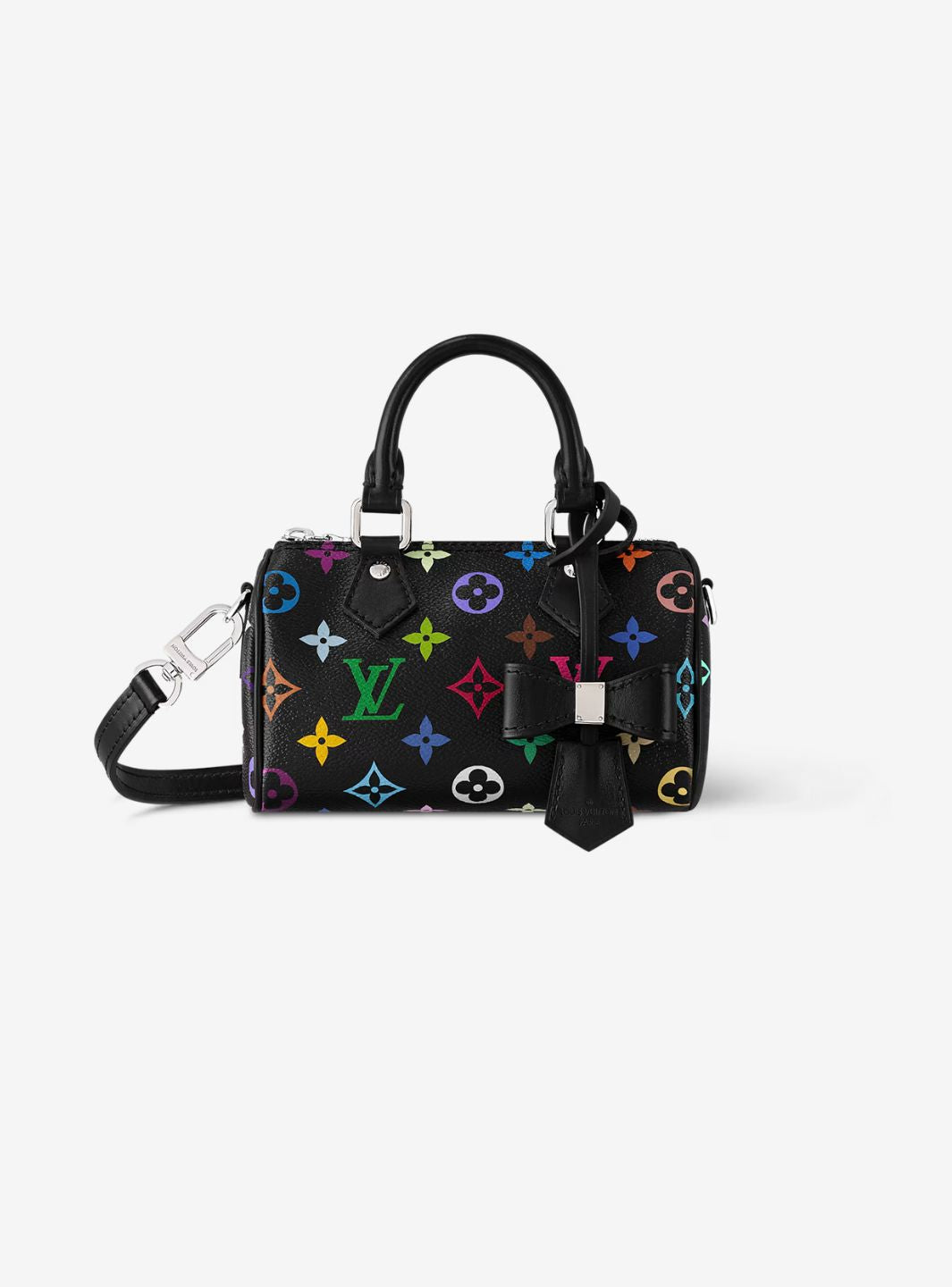
The Japanese artist took the classic Monogram and transformed it into the famous Monogram Multicolore, using dozens of shades on white or black bases.
The Speedy became one of the perfect canvases for this new language.
The result was the opposite of discretion: the Louis Vuitton logo became the absolute star, and the bag fully entered the pop aesthetic of the 2000s.

Today, this part of the Louis Vuitton story has become particularly relevant again through new Murakami reinterpretations. On ResellZone, for example, there is the Louis Vuitton x Takashi Murakami Nano Speedy Black.

The vintage Speedy and the secondary market
The long history of the model means that there are Speedys on the market belonging to extremely different eras, materials, and collections.
A vintage Monogram Speedy may show patina on the cowhide, minor signs of wear, and variations in the canvas that tell the bag’s life story directly.
This does not automatically mean that an older bag has more value.
The valuation depends on numerous factors: model, year, collaboration, condition, size, completeness of accessories, and demand.
A normal Monogram Speedy and a rare Speedy created in collaboration with an artist, therefore, belong to very different collector markets.
How to recognize an original Louis Vuitton Speedy?
The popularity of the Speedy has inevitably made it one of the most replicated bags.
Authentication should never be based on a single element.
The canvas, proportions, stitching, hardware, zipper, handles, cowhide, interior, identification codes, and specific characteristics of the production period must all be analyzed simultaneously.
An important detail is the period itself: Louis Vuitton has changed its identification and production systems over time, so a rule that is valid for a recent Speedy might not be for a vintage one.
For this reason, authenticity must be evaluated in the correct context and not simply by comparing a single code found online.
The Nano Speedy: the icon goes mini
The evolution of the Speedy did not only come through collaborations.
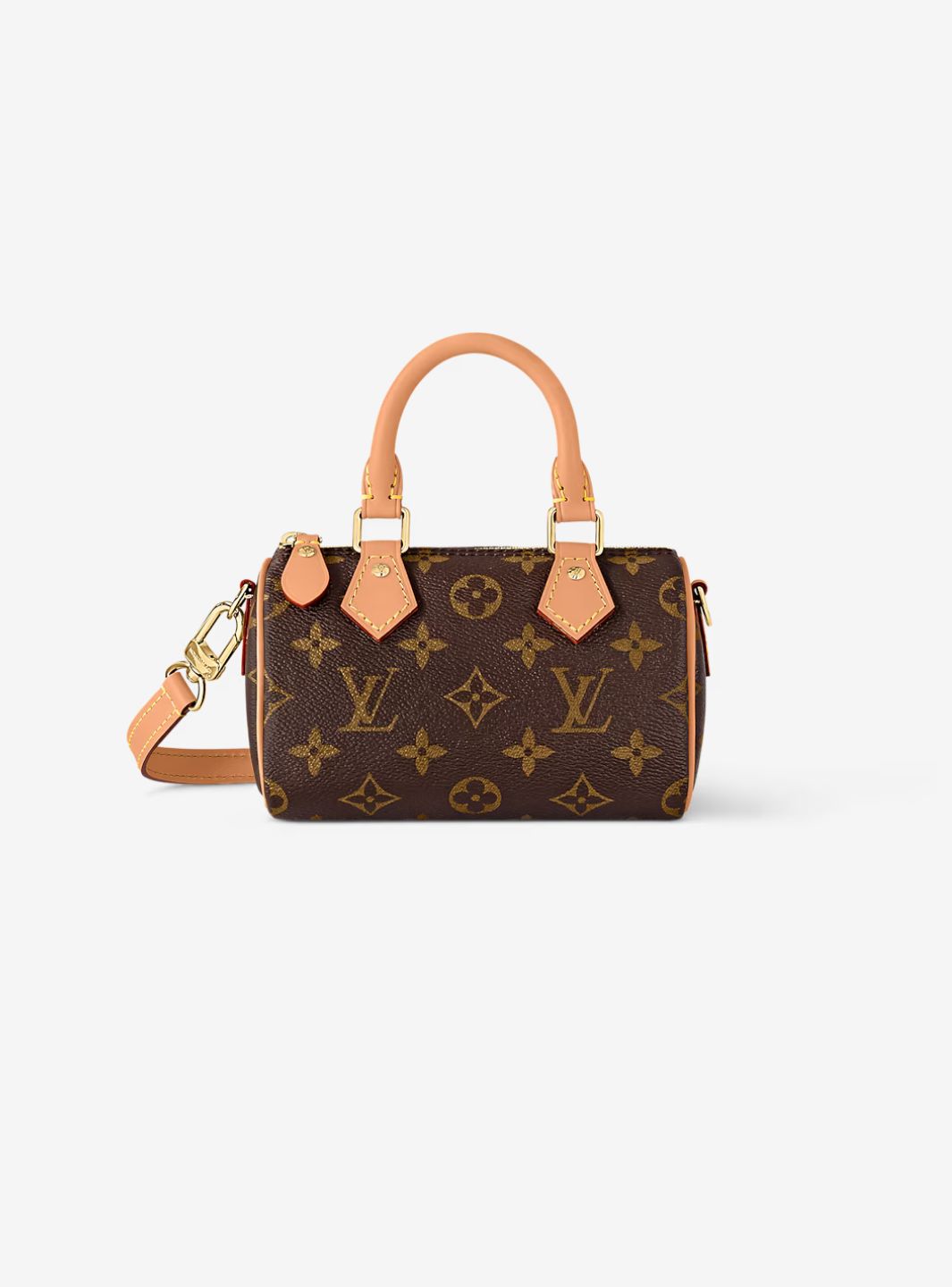
Over the years, Louis Vuitton has progressively shrunk the silhouette until arriving at the Nano Speedy, which maintains the fundamental elements of the original model in extremely compact dimensions.
It is an interesting transformation because it starts with a bag born for travel and takes it to almost the opposite extreme: an accessory designed to hold only the essential items.
The Louis Vuitton Nano Speedy Monogram still maintains the rounded shape, the handles, and the Monogram that make the family instantly recognizable.
Pharrell Williams brings the Speedy back to the center of fashion
A new chapter begins with the arrival of Pharrell Williams as Creative Director of Louis Vuitton Men's.
During his first collection for the Maison, Pharrell took the Speedy and transformed it into one of the main symbols of the new era.
The Speedy P9 was born.
The silhouette remains tied to the original, but the perception of the materials and colors changes completely.
While the classic Speedy is known primarily for its Monogram canvas, the P9 is crafted in soft LV Buttersoft leather on which the Monogram is screen-printed.
What is the Louis Vuitton Speedy P9?
The Speedy P9 is the reinterpretation of the bag signed by Pharrell Williams.
The name retains the Speedy reference but identifies a more contemporary family, characterized above all by the use of leather and a softer aesthetic.
Louis Vuitton creates every bag through dozens of components and numerous manual processes, maintaining historical elements like handles, a padlock, and the general structure.
What changes the most, however, is the way the bag is perceived: no longer just a classic icon of women's leather goods, but also a central object in Pharrell's universe of menswear and street-luxury.
The million-dollar Speedy
One of the moments that attracted the most attention to the new Speedy was the appearance of an extremely exclusive version associated with Pharrell.
Online, it became famous as the Millionaire Speedy: a reinterpretation made with precious materials and jewelry-like details that contributed to transforming the Speedy into an object of global conversation once again.
But the interesting point is not just the price.
The project demonstrates how the same silhouette can live in two extremes simultaneously: from the Monogram Speedy designed for daily use to an almost haute-luxury collector’s piece.
2026: 130 years of the Monogram and the return of the Speedy
In 2026, Louis Vuitton celebrates 130 years of the Monogram, and the Speedy returns once again to the center of the Maison's story.
New capsules reinterpret the pattern through different materials and constructions, confirming how this bag has become one of the favorite surfaces for telling the story of Louis Vuitton.
It is significant that a silhouette created almost a century ago continues to be used to celebrate one of the most important symbols of the Maison.
Which Louis Vuitton Speedy to choose?
There is no universally better size.
For those looking for a compact everyday bag, the Speedy 20 and 25 are generally the most modest options.
The Speedy 30 offers greater capacity while maintaining proportions that are still easily used daily.
35 and 40, on the other hand, are closer to the original nature of the model as a travel bag.
Those who want more versatility may prefer the Bandoulière, while the Nano Speedy and collaborative versions have a more fashion-forward and collectible character.
Within the Louis Vuitton selection on ResellZone, very different interpretations of the Maison coexist, from historical silhouettes to the most contemporary projects.
Why the Louis Vuitton Speedy is still an icon
The Speedy manages to do something that few fashion products truly achieve: to change continuously without losing its identity.
It was born as the Express in the 1930s, entered the world of the Monogram in 1959, was transformed into the Speedy 25 for Audrey Hepburn in 1965, passed through the artistic collaborations of the 2000s, and arrived at Pharrell Williams' P9.
Every era has used the same silhouette to tell something different.
And this is likely the true reason why the Louis Vuitton Speedy continues to be relevant: it has not remained frozen in the past, but has allowed nearly one hundred years of fashion, art, and pop culture to leave a mark on the same shape.