

Fragment Design is one of the most influential names in sneaker culture, even if its logo often occupies just a few centimeters of a shoe. Behind the famous double lightning bolt is Hiroshi Fujiwara, designer, musician, and a central figure in Japanese streetwear, capable of creating collaborations that have become true collector's items over the years.
From the legendary 2014 Air Jordan 1 Fragment to the triple collaborations with Travis Scott, through Nike Dunk, Sacai, Air Jordan 3, and the recent Union LA x Fragment, Fujiwara’s language has remained surprisingly consistent: a few elements, carefully considered colors, and seemingly simple modifications that nevertheless manage to completely change the perception of a sneaker.
Today, the collaboration between Hiroshi and Nike continues through Fragment Concept Testing, demonstrating that Fragment is not just an hype-driven phenomenon, but a presence that spans decades of footwear history.
Who is Hiroshi Fujiwara?
Hiroshi Fujiwara is considered one of the figures who contributed most to the birth and development of modern Japanese streetwear.
Before becoming a designer, Fujiwara navigated music, DJ culture, punk, and hip-hop. During the eighties, he came into contact with Western cultural scenes that he later reinterpreted within the Japanese context.
His influence grew primarily in Tokyo and the Harajuku area, where fashion, music, skate culture, and sneakers began to blend, creating a language that would go global in the following years.
Fujiwara did not build his role solely as a stylist. Rather, he became a cultural curator: he discovers products, modifies existing objects, connects different worlds, and transforms seemingly simple collaborations into something desirable.
What is Fragment Design?
Fragment Design was founded in the early 2000s as Hiroshi Fujiwara's creative project.
More than a standard clothing brand, Fragment functions as a sort of laboratory: it collaborates with different companies and applies its own language to sneakers, fashion, technology, objects, and lifestyle products.
Its most recognizable symbol is the double lightning bolt, which has become one of the logos most immediately associated with the world of streetwear collaborations over the years.
The Fragment philosophy can be summarized in a few concepts:
- minimalism, with interventions often much more restrained compared to other collaborations;
- selection, because Fujiwara tends to work on models or projects with a strong identity;
- collaboration, which is an integral part of the Fragment DNA;
- rarity, often due to limited or particularly selective distribution.
And it is precisely this apparent simplicity that has made Fragment so recognizable.
Hiroshi Fujiwara and Nike: a story that began before Fragment
The relationship between Hiroshi Fujiwara and Nike is much older than many of the Fragment collaborations known today.
In fact, Fujiwara began working with Nike as early as the late nineties and subsequently became one of the founding members of HTM, the collective formed together with Tinker Hatfield and Mark Parker.
HTM represented a sort of experimental laboratory within Nike culture: new technologies, materials, and interpretations of classic silhouettes were developed in limited quantities, often anticipating ideas that would later arrive on more mass-market products.
This relationship helps to understand one important thing: Fragment does not enter the Nike world simply as a famous brand to be printed on a sneaker. Fujiwara already had a deep creative relationship with the company.
Air Jordan 1 Fragment 2014: the sneaker that became a legend
If one must choose a sneaker capable of representing Fragment Design, it is probably the 2014 Air Jordan 1 High Fragment.
The shoe uses a combination of white, black, and blue that recalls the classic color blocking of the first Air Jordan 1s, but introduces the Fragment blue and, above all, the small double lightning bolt logo embossed on the heel.
There are no extreme constructions or particularly flashy elements. It is precisely this cleanliness that makes it perfectly consistent with Fujiwara’s language.
Over the years, the 2014 Jordan 1 Fragment has become one of the most recognizable collaborations in the entire modern history of the Jordan Brand and a reference point for many subsequent projects.
On ResellZone, you can check availability and sizes for the Air Jordan 1 Retro High Fragment.
Fragment x Travis Scott x Air Jordan 1 High 2021
In 2021, the story changed again when Fragment Design, Travis Scott, and Jordan Brand were reunited on the same sneaker.
The Air Jordan 1 High Travis Scott x Fragment combines some of the most recognizable codes of the three worlds: the Reverse Swoosh of Travis Scott, the blue associated with Fragment, and the structure of the Jordan 1 High.
The result is a triple collaboration in which none of the partners completely overshadows the others.
The large Reverse Swoosh dominates the outer side, while Cactus Jack and Fragment branding are inserted more discreetly.
You can see the model on the page dedicated to the Air Jordan 1 High Travis Scott x Fragment.
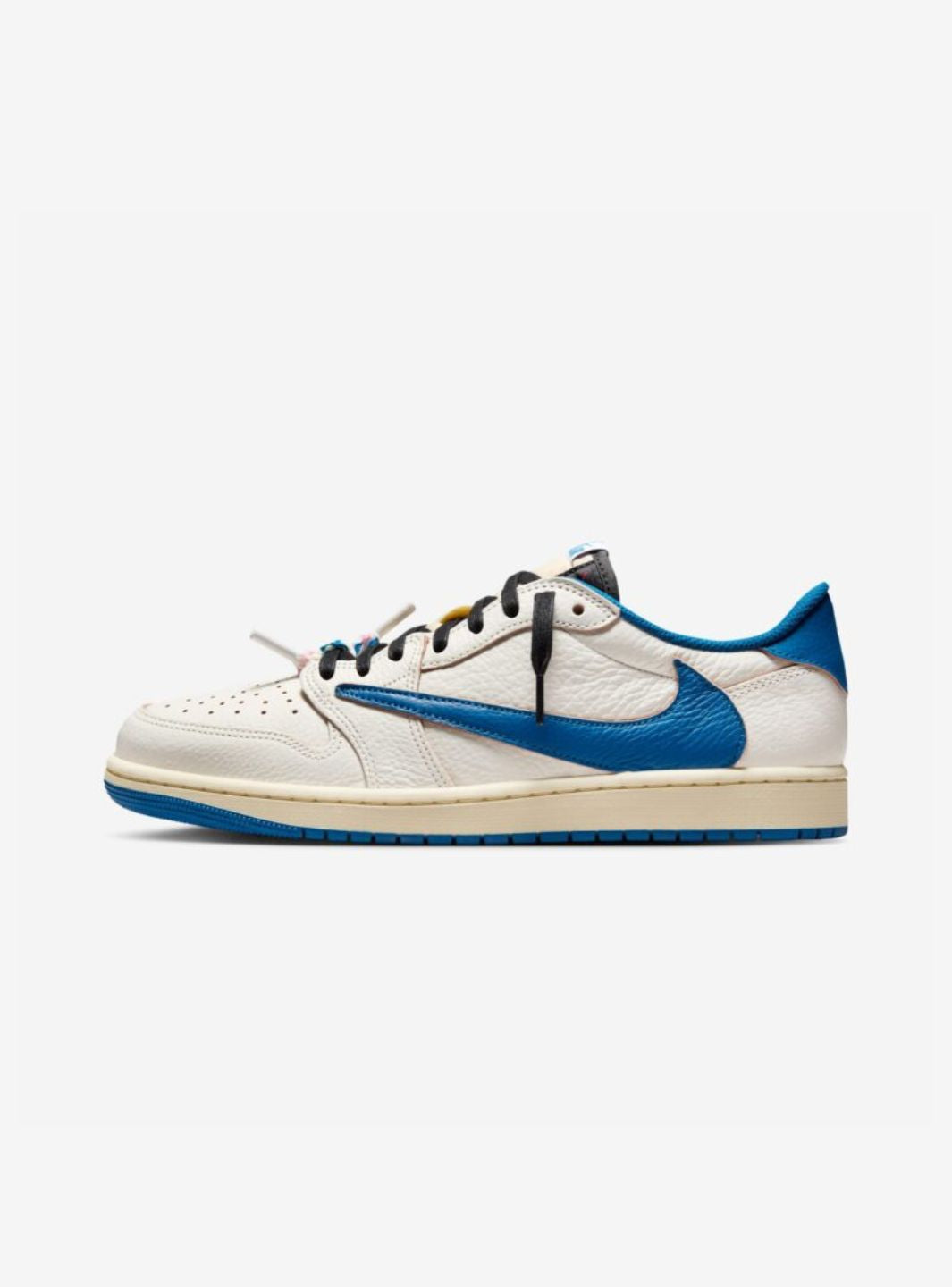
Air Jordan 1 Low Travis Scott x Fragment
The same year also saw the arrival of the Air Jordan 1 Low Travis Scott x Fragment, destined to become one of the most recognizable collaborative Jordan 1 Lows of recent years.
The white, black, and Military Blue palette directly recalls the Fragment identity, while the Reverse Swoosh maintains the immediate connection with Travis Scott.
Compared to the High, the Low has a simpler construction for everyday wear, but keeps the power of the collaboration virtually intact.
The original 2021 model is also present in the ResellZone selection dedicated to the Jordan 1 Low Fragment x Travis Scott.
Travis Scott x Fragment Sail Military Blue
The collaboration between Fragment, Travis Scott, and Jordan did not stop in 2021.
With the Air Jordan 1 Low OG SP Sail Military Blue, the trio picks up some of the elements that had made the previous release famous, but places them in a lighter palette.
Sail, white, and Military Blue build a sneaker with less contrast than the previous one, while the Reverse Swoosh remains one of the immediately recognizable elements.
You can compare it with the first version via the Jordan 1 Low Travis Scott Fragment Sail Military Blue.
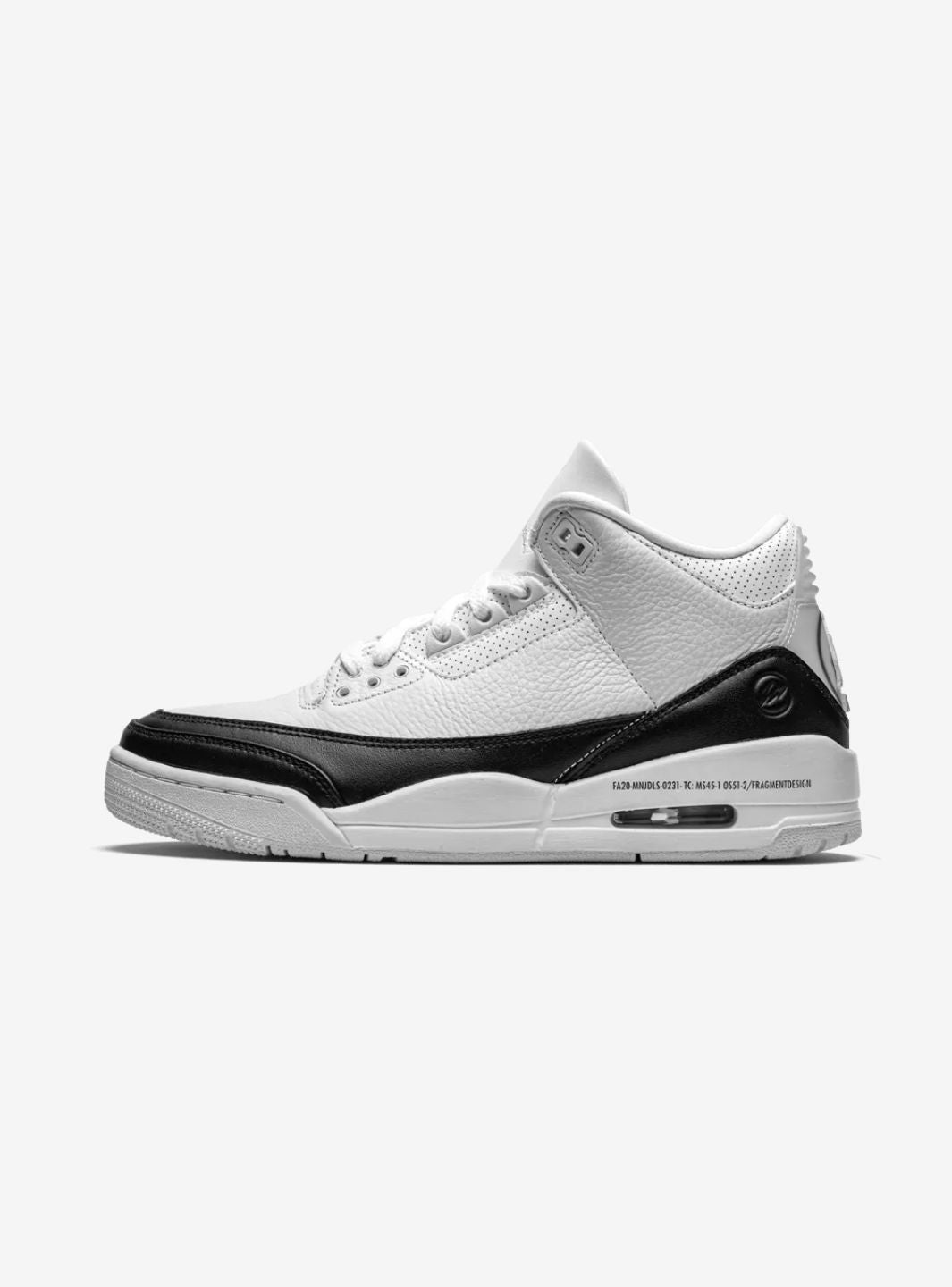
Air Jordan 3 Fragment 2020
Fragment did not only work on the Jordan 1.
In 2020, Hiroshi Fujiwara also reinterpreted the Air Jordan 3, once again choosing an extremely essential palette.
The sneaker features a predominantly white construction with a black mudguard and Fragment branding. The result is much more sober compared to numerous collaborative Jordans, perfectly in line with Fujiwara’s approach.
A particularly interesting detail is the branding on the heel, where Fragment elements are integrated into the sneaker's structure without transforming it into an overly decorated product.
The Air Jordan 3 Fragment White Black remains one of the cleanest interpretations of the silhouette even today.
Nike Dunk Low CLOT x Fragment
One of the projects that best tells the story of Fragment's ability to collaborate with other Asian brands is the Nike Dunk Low CLOT x Fragment.
Here, Fujiwara’s aesthetic meets that of CLOT, a brand founded by Edison Chen and Kevin Poon.
The sneaker uses a predominantly white construction with materials designed to change their aesthetic through wear and customization, continuing a tradition very present in CLOT collaborations.
The result brings together two different visions of Asian streetwear on one of the most important Nike Dunk silhouettes.
The model is available on the page dedicated to the Nike Dunk Low CLOT x Fragment White.
Nike Sacai LDWaffle x Fragment Grey
When Fragment meets Sacai, Fujiwara’s minimalism has to coexist with a completely different design.
The Nike LDWaffle by Chitose Abe is in fact built on duplication: double Swoosh, double tongue, and double midsole components.
Fragment intervenes primarily through the palette.
The Nike Sacai LDWaffle Fragment Grey uses gray and white tones that visually reduce the complexity of the silhouette and make the design much more sober.
Nike Sacai LDWaffle x Fragment Blue Void
The same collaboration is also offered in the Blue Void colorway.
The structure remains the typically experimental one of the LDWaffle, but the dark blue creates a more decisive result while still maintaining the clean approach of Fragment.
The Nike LDWaffle Sacai Fragment Blue Void clearly demonstrates a recurring characteristic of Fujiwara’s work: it is not always necessary to completely modify a silhouette to change its identity.
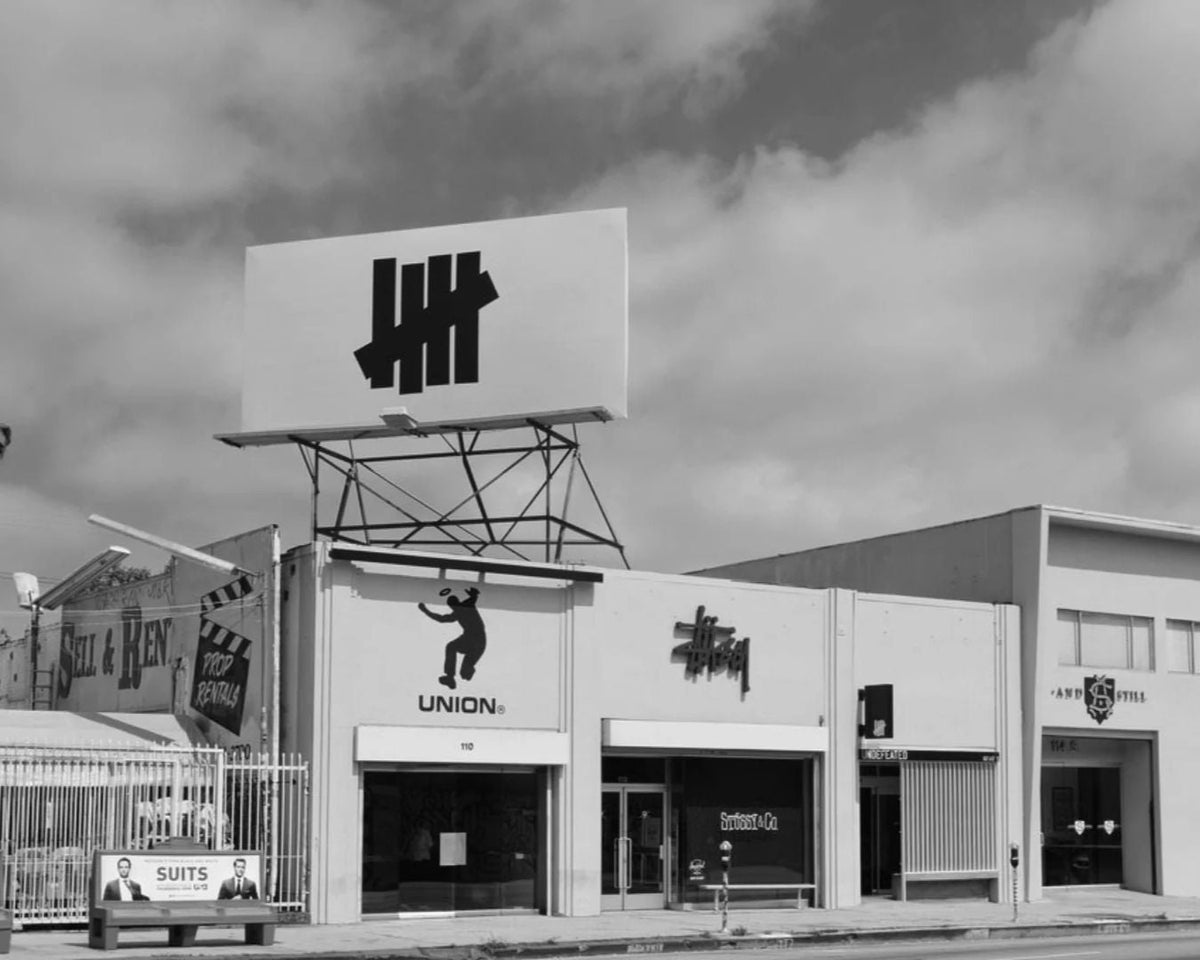
Union LA x Fragment x Air Jordan 1: the return to 2014
In 2026, Fragment returns to the Air Jordan 1 High, this time together with Union Los Angeles.
The collaboration brings together two already highly recognizable languages.
On one side we find the color blocking and the Fragment double lightning bolt; on the other, the stitching on the collar and the deconstructed construction that became characteristic of Union’s Jordan 1s.
The project is particularly interesting because some colorways openly recall the historic 2014 Jordan 1 Fragment, but reinterpret them through the identity of Chris Gibbs and Union LA.
We have explored all versions, differences, and distribution in the article dedicated to the Air Jordan 1 Union LA x Fragment.
Fragment Concept Testing: the new chapter with Nike in 2026
The history between Hiroshi Fujiwara and Nike is not limited to retro sneakers, however.
In 2026, Fragment Concept Testing was presented, a project through which Fujiwara returns to work directly on Nike’s most recent technologies and silhouettes.
Among the first models, we find the Nike Mind 001, Mind 002, and Air Liquid Max.
It is a return that is particularly consistent with the origins of the relationship between Fujiwara and Nike: instead of limiting himself to reinterpreting historical models, Fragment returns to using the collaboration as a space for experimentation.
The Mind 001 Fragment, for example, maintains the technological structure of the Nike Mind family but is reinterpreted through a black colorway with blue elements and Fragment branding.
This new chapter demonstrates how Fujiwara’s work does not live solely on nostalgia or old grails.
Why is the Fragment logo a double lightning bolt?
The Fragment double lightning bolt has become one of the most recognizable symbols of contemporary streetwear.
On sneakers, it is often used in an extremely discreet way: engraved on the heel, printed on an insole, or inserted among other branding elements.
It is precisely this discretion that makes it particularly effective.
A Jordan or a Nike Fragment does not necessarily need to have a huge logo to be recognizable. Often, a color palette, printed product codes, and small lightning bolts are enough to identify it.
The most important Fragment Design collaborations
Fragment’s history with Nike and Jordan is now long enough to make a definitive ranking difficult. However, some models have had a particular impact:
- 2014 Air Jordan 1 High Fragment;
- 2020 Air Jordan 3 Fragment;
- 2021 Air Jordan 1 High Travis Scott x Fragment;
- 2021 Air Jordan 1 Low Travis Scott x Fragment;
- Nike Sacai LDWaffle x Fragment;
- Nike Dunk Low CLOT x Fragment;
- 2026 Air Jordan 1 Union LA x Fragment;
- 2026 Nike Mind 001 and Mind 002 Fragment Concept Testing.
These are not necessarily the only important Fujiwara collaborations, but they tell the story of the evolution of the relationship between Fragment, Nike, and the Jordan Brand well.
Why are Fragment sneakers so sought after?
Rarity alone is not enough to explain the success of Fragment.
Many sneakers are produced in limited quantities without managing to build the same cultural weight.
In the case of Fragment, several elements come into play: Hiroshi Fujiwara’s history, the multi-decade relationship with Nike, the selection of silhouettes, the recognizable design, and the continuity of the project.
A 2014 Jordan Fragment and a 2026 Nike Mind Fragment are completely different products, but they still share a recognizable design logic.
And it is this continuity that transforms the double lightning bolt from a simple collaborative logo into a true code of sneaker culture.
Do Fragments always increase in value?
No. And it is important to clarify this.
The fact that some Fragments have become extremely expensive on the secondary market does not mean that every sneaker with the double lightning bolt is automatically an investment.
Prices and demand depend on the model, availability, size, condition, distribution, and market interest at a given moment.
Some historical releases have become grails, while others have performed much more normally.
For this reason, it is more correct to evaluate each model individually instead of considering Fragment as an automatic guarantee of appreciation.
Fragment Design beyond the hype
Perhaps the most interesting thing about Hiroshi Fujiwara is his ability to remain relevant without completely changing his identity with every collaboration.
From the experimentation with Nike HTM to the 2014 Jordan 1 Fragment, from the triple collabs with Travis Scott to Union LA and Fragment Concept Testing, the principle remains similar: take something already strong and modify it just enough to make it seem new.
Fragment Design has not built its importance on the quantity of modifications, but on the precision of its choices.
And this is probably the reason why, after decades of collaborations, a few centimeters occupied by a double lightning bolt continue to be enough to transform a normal Nike or Jordan release into one of the most observed sneakers of the moment.









2 comments
ALberto
Le collaborazioni tra Nike e HF/ Fragment sono e saranno tante, ma magari una citazione delle prime J1, si quelle in copertina del magazine l’avrei messa anche se non sono in vendita.🙃
Le collaborazioni tra Nike e HF/ Fragment sono e saranno tante, ma magari una citazione delle prime J1, si quelle in copertina del magazine l’avrei messa anche se non sono in vendita.🙃
Batt
Storia molto affascinante! Bello l’articolo! Bravi Batt e Centralino!
Storia molto affascinante! Bello l’articolo! Bravi Batt e Centralino!